


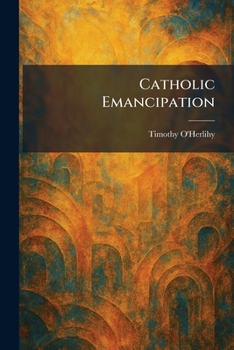
Catholic Emancipation

"Catholic Emancipation" provides a profound historical examination of one of the most pivotal movements in the nineteenth-century British Isles. Written by Timothy O'Herlihy, this work explores the complex socio-political and religious struggle that culminated in the Catholic Relief Act of 1829. The book delves into the systemic disenfranchisement of Catholics under the Penal Laws and the long, arduous road toward restoring their civil rights and political liberties.
Through a detailed analysis, O'Herlihy highlights the critical roles played by key figures, most notably Daniel O'Connell and his Catholic Association, whose grassroots mobilization changed the course of Irish and British history. The narrative captures the tension between the Irish populace and the British establishment, illustrating how the movement for emancipation became a catalyst for broader democratic reforms and national identity in Ireland.
This scholarly yet accessible account serves as a vital resource for readers interested in Irish history, ecclesiastical history, and the evolution of religious tolerance. By situating the event within its broader historical context, "Catholic Emancipation" offers valuable insights into the intersection of faith and governance, making it an essential study of a transformative era in political history.
This work has been selected by scholars as being culturally important, and is part of the knowledge base of civilization as we know it. This work was reproduced from the original artifact, and remains as true to the original work as possible. Therefore, you may see the original copyright references, library stamps (as most of these works have been housed in our most important libraries around the world), and other notations in the work.
This work is in the public domain in the United States of America, and possibly other nations. Within the United States, you may freely copy and distribute this work, as no entity (individual or corporate) has a copyright on the body of the work.
As a reproduction of a historical artifact, this work may contain missing or blurred pages, poor pictures, errant marks, etc. Scholars believe, and we concur, that this work is important enough to be preserved, reproduced, and made generally available to the public. We appreciate your support of the preservation process, and thank you for being an important part of keeping this knowledge alive and relevant.
Customer Reviews
ThriftBooks ® and the ThriftBooks ® logo are registered trademarks of Thrift Books Global, LLC
