


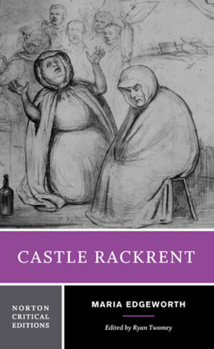
Castle Rackrent: A Norton Critical Edition


Select Format
Select Condition 
Book Overview
Castle Rackrent's publication in 1800 signaled many firsts: the first historical novel, the first regional novel in English, the first "big house" novel, the first Anglo-Irish novel, and the first novel with a narrator who is neither reliable nor part of the action. This Norton Critical Edition is based on the Baldwin & Cradock edition that appeared as part of an eighteen-volume collected edition titled Tales and Novels of Maria Edgeworth (1832-33). It is accompanied by detailed explanatory annotations.
Ryan Twomey focuses the volume's "Backgrounds and Contexts" on Edgeworth's importance as a writer, the influence of contemporary historical events on her writing (most importantly, the Act of Union of 1800, which united Ireland and Great Britain), and Castle Rackrent's impact on the development of the novel. These include a selection of Edgeworth's letters; five major contemporary reviews; biographical pieces; Sir Walter Scott on Edgeworth and her response to him; and excerpts from Edgeworth's juvenilia, The Double Disguise.
"Criticism" is thematically organized to give readers a clear sense of Castle Rackrent's major themes: Irish writing and specifically the Irish novel, narrative voices, patriarchy and paternalism, and Edgeworth's Hiberno-English writing. Contributors include Seamus Deane, Marilyn Butler, Katherine O'Donnell, Julia Nash, Joyce Flynn, and Brian Hollingworth, among others.
A chronology of Edgeworth's life and work and a selected bibliography are also included.
Ryan Twomey focuses the volume's "Backgrounds and Contexts" on Edgeworth's importance as a writer, the influence of contemporary historical events on her writing (most importantly, the Act of Union of 1800, which united Ireland and Great Britain), and Castle Rackrent's impact on the development of the novel. These include a selection of Edgeworth's letters; five major contemporary reviews; biographical pieces; Sir Walter Scott on Edgeworth and her response to him; and excerpts from Edgeworth's juvenilia, The Double Disguise.
"Criticism" is thematically organized to give readers a clear sense of Castle Rackrent's major themes: Irish writing and specifically the Irish novel, narrative voices, patriarchy and paternalism, and Edgeworth's Hiberno-English writing. Contributors include Seamus Deane, Marilyn Butler, Katherine O'Donnell, Julia Nash, Joyce Flynn, and Brian Hollingworth, among others.
A chronology of Edgeworth's life and work and a selected bibliography are also included.
Format:Paperback
Language:English
ISBN:0393922413
ISBN13:9780393922417
Release Date:October 2014
Publisher:W. W. Norton & Company
Length:224 Pages
Weight:0.67 lbs.
Dimensions:0.7" x 5.0" x 8.3"
Customer Reviews
1 rating
Unsettling Anglo-Irish Social Satire
Published by Thriftbooks.com User , 25 years ago
Maria Edgeworth's "Castle Rackrent," published in 1800, the year of Irish union with Great Britain, and just two years after the 1798 Irish Rebellion, is supposedly a comic satire intended to show after years of unrest, that the Irish were civil enough to be assimilated into the British Empire. That is a deceptively simple description of a book in conflict with its author and itself. Told to an "editor" by Thady Quirk, the 80+ year old steward of the Rackrent estate relates (very quickly) the story of the Rackrent family, Sir Patrick, Sir Murtagh, Sir Kit, and the absolutely dissolute Sir Condy. The O'Shaughlin family is forced by the Penal Laws to become Protestant and to change their name to Rackrent to regain their estate. The variously weak Rackrent men and their extremely strong and independent wives spend themselves into outrageous debt and tax their tenant farmers to the point of insanity over the course of the novel. Apply Katie Trumpener's argument regarding the importance of the bog to Irish cultural nationalism in her book "Bardic Nationalism," and you begin to see that, all that seems to preserve the legacy of the O'Shaughlin family is their mucky bog, Allyballycarricko'shaughlin, and Thady Quirk, if he is to be trusted, himself seemingly stuck in a feudal past.One of the major questions posed by Edgeworth's novel is "What is it to be Irish?" The Anglo-Irish Rackrent landlords claim an Irish Catholic heritage, but forfeit that personal history for the ephemeral run of the estate. The disenfranchised tenant farmers are forced to yield their produce to support the Rackrents's absurd behaviours. In the middle of this dynamic stand the novel's two most developed and challenging characters, Sir Condy Rackrent and Jason McQuirk, Thady's son. Raised in identical circumstances, these two seem to mark the novel's ultimate judgment on the future of Ireland. Is Condy the last of the feudal Irish aristocracy? Does Jason represent the model for the "British" assimilated Irishman?Can outsiders even fathom Irishness? An almost comically unwieldy editorial apparatus, including a glossary and internal footnotes try to neutralize the foreignness and threat of the Irish for Edgeworth's intended British audience. "Castle Rackrent" is indeed an ambivalent testament to the future of the Irish nation as it is swallowed up into the British Empire at the turn of the 19th century, and an intriguing read.
Copyright © 2026 Thriftbooks.com
Terms of Use | Privacy Policy | Do Not Sell/Share My Personal Information | Cookie Policy | Cookie Preferences | Accessibility Statement
ThriftBooks ® and the ThriftBooks ® logo are registered trademarks of Thrift Books Global, LLC
ThriftBooks ® and the ThriftBooks ® logo are registered trademarks of Thrift Books Global, LLC
