


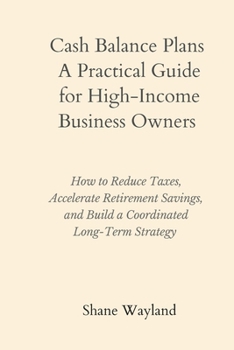
Cash Balance Plans: A Practical Guide for High-Income Business Owners

Most high-income business owners don't have a tax problem.
They have a structure problem.
As income grows, the strategies that once worked quietly stop scaling. Retirement plans cap out. Deductions flatten. Taxes accelerate. And the advice stays the same-max the plan, invest the rest, keep going-even when it no longer fits the reality of the business.
Cash Balance Plans is not a sales pitch and it's not a technical manual. It's a clear, honest explanation of why planning begins to feel misaligned at higher income levels-and why Cash Balance Plans force that misalignment into the open.
Written for business owners, professionals, and closely held companies, this book explains:
Why traditional retirement planning stops working as income rises
What Cash Balance Plans actually are, without jargon or hype
Who these plans are designed for-and who should walk away
How contributions are calculated and why the numbers can feel so large
Why these plans demand structure, discipline, and long-term thinking
How poor coordination turns powerful strategies into expensive mistakes
When saying "not yet" is the smartest decision you can make
This book doesn't promise shortcuts. It doesn't minimize responsibility. And it doesn't pretend that every business should use this strategy.
Instead, it treats Cash Balance Plans for what they really are: a pressure test.
Used correctly, they create clarity, discipline, and scale where improvisation used to exist. Used poorly, they expose instability just as quickly.
Whether you ultimately implement a Cash Balance Plan or not, this book will change how you think about:
Retirement planning
Tax strategy
Cash flow commitments
And the role structure plays in long-term success
If you've reached the point where making more money no longer feels like progress, this book will help you understand why-and what changes when planning finally catches up.
Who This Book Is For
High-income business owners and professionals
Owners in their 40s, 50s, and beyond
Closely held companies and partnerships
Readers who value clarity over complexity
Who This Book Is Not ForEarly-stage businesses
Readers looking for loopholes or one-year tax tricks
Anyone unwilling to trade flexibility for structure
Customer Reviews
ThriftBooks ® and the ThriftBooks ® logo are registered trademarks of Thrift Books Global, LLC
