


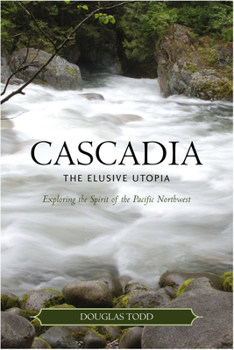
Cascadia: the Elusive Utopia : Exploring the Spirit of the Pacific Northwest

Select Format
Select Condition 
Book Overview
This collection explores the unique spirituality and culture of Cascadia, which includes British Columbia, Washington and Oregon. Envied around the world, Cascadia is famous for its mountains, evergreens, and livable cities. Less well known is that Cascadia is home to the least institutionally religious people on the continent. Despite this, Cascadia: The Elusive Utopia argues that most of the region's 14 million residents feel deeply " spiritual." Many gain their sense of the sacred from the spectacular and imposing land. Brought together by critically acclaimed Vancouver Sun writer Douglas Todd, 15 leading writers, scholars, bio-regionalists, pollsters, aboriginals, economists, philosophers and literary specialists explain how the Pacific Northwest is nurturing a unique " spirituality of place," which could become a model for the planet. In this book readers will find a vision of a healthy future: an elusive utopia. Canadian and American contributors include historian Jean Barman, Canadian poet laureate George Bowering, political philosopher Philip Resnick, religion scholar Patricia O' Connell Killen and American-Canadian eco-thinker Sallie McFague.
Format:Paperback
Language:English
ISBN:1553800605
ISBN13:9781553800606
Release Date:August 1970
Publisher:Ronsdale Press
Length:240 Pages
Weight:0.13 lbs.
Dimensions:0.7" x 6.0" x 9.0"
Customer Reviews
1 rating
Cascadia: Elusive and Exclusive!
Published by Thriftbooks.com User , 17 years ago
For me, Cascadia is also an exclusive utopia. There's nothing quite like it on the North American continent. Douglas Todd's thought-provoking book illustrates the point by means of demographic studies, philosophical discussions, and observations of perspectives relevant to religion and spirituality, expressed by several authors. Of course, it cannot be denied Cascadia is an elusive community, first and foremost. That's the way it is with utopias. For years I thought "utopia" meant a "good place." But I failed to notice the Greek spelling. Had it been rendered "outopia," I might have caught on sooner. It translates to "no place." Upon further reflection, I have come to realize how perceptive that meaning is. Still, there can be a kind of utopia within the human spirit, and it is this utopia that I sense in Cascadia--a burgeoning phenomenon in British Columbia, Washington and Oregon. Todd's book brings me to a personal awareness of the Cascadia within. I had never before defined myself in quite that way. I especially wish to thank Douglas Todd for including Dr. Eleanor Stebner's essay, "Let the Salmon be Salmon: the International Peace Arch as Symbol and Challenge," in his book. I live only one block from Peace Arch State Park and its adjoining sister, Peace Arch Provincial Park. I have long believed the Peace Arch deserves a higher profile and a greater meaning for all people who hold an interest in world peace.
Copyright © 2026 Thriftbooks.com
Terms of Use | Privacy Policy | Do Not Sell/Share My Personal Information | Cookie Policy | Cookie Preferences | Accessibility Statement
ThriftBooks ® and the ThriftBooks ® logo are registered trademarks of Thrift Books Global, LLC
ThriftBooks ® and the ThriftBooks ® logo are registered trademarks of Thrift Books Global, LLC
