


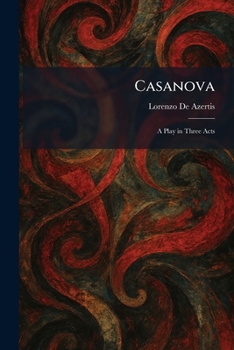
Casanova: A Play in Three Acts

"Casanova: A Play in Three Acts" is a compelling dramatic work by Lorenzo De Azertis that brings to life the legendary figure of Giacomo Casanova. Set against the vibrant and often scandalous backdrop of 18th-century Europe, this three-act play explores the complexities of one of history's most famous adventurers, lovers, and polymaths. Rather than a mere chronicle of conquests, the drama delves into the charisma, wit, and vulnerability of a man whose name became synonymous with seduction.
Through sharp dialogue and theatrical flair, De Azertis captures the essence of the Venetian atmosphere, portraying Casanova not just as a rogue, but as a figure of intellectual depth caught in the shifting social tides of his era. The play serves as both a character study and a window into the aristocratic circles and clandestine encounters of the Enlightenment. "Casanova: A Play in Three Acts" remains a significant piece of early 20th-century theatre, offering a sophisticated interpretation of a historical icon whose life continues to fascinate audiences and readers alike. Its structure provides a rhythmic and engaging journey through the trials and triumphs of a man who lived life as an art form.
This work has been selected by scholars as being culturally important, and is part of the knowledge base of civilization as we know it. This work was reproduced from the original artifact, and remains as true to the original work as possible. Therefore, you may see the original copyright references, library stamps (as most of these works have been housed in our most important libraries around the world), and other notations in the work.
This work is in the public domain in the United States of America, and possibly other nations. Within the United States, you may freely copy and distribute this work, as no entity (individual or corporate) has a copyright on the body of the work.
As a reproduction of a historical artifact, this work may contain missing or blurred pages, poor pictures, errant marks, etc. Scholars believe, and we concur, that this work is important enough to be preserved, reproduced, and made generally available to the public. We appreciate your support of the preservation process, and thank you for being an important part of keeping this knowledge alive and relevant.
Customer Reviews
ThriftBooks ® and the ThriftBooks ® logo are registered trademarks of Thrift Books Global, LLC
