


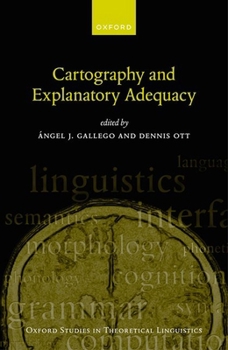
Cartography and Explanatory Adequacy
No Customer Reviews

This book contributes to the ongoing empirical, conceptual, and meta-theoretical debates regarding the merits and drawbacks of the cartographic program in linguistic theory. Although cartography has its roots in the study of the left periphery, its empirical scope has expanded significantly over the years and now covers a wide range of domains such as argument structure, modification, and constituent order. The chapters in this volume offer a critical examination of the cartographic assumption that there is a rich array of functional projections whose hierarchical order is fixed and determined by Universal Grammar. They discuss the nature of these cartographic hierarchies and their relation to the central theoretical goal of explanatory adequacy: are functional hierarchies an irreducible property of Universal Grammar (hence constituting part of the "residue" beyond the scope of principled explanation), or are they emergent, deriving from independent principles that do not require a further enrichment of Universal Grammar?
Format:Hardcover
Language:English
ISBN:019886793X
ISBN13:9780198867937
Release Date:September 2024
Publisher:Oxford University Press
Length:336 Pages
Weight:1.40 lbs.
Dimensions:1.0" x 6.0" x 8.8"
Customer Reviews
0 rating
Copyright © 2026 Thriftbooks.com Terms of Use
| Privacy Policy | Do Not
Sell/Share My Personal Information | Cookie Policy | Cookie Preferences | Accessibility Statement
ThriftBooks® and the ThriftBooks® logo are registered trademarks of Thrift Books Global, LLC
ThriftBooks® and the ThriftBooks® logo are registered trademarks of Thrift Books Global, LLC
