


Carnaval!

Select Format
Select Condition 
Book Overview
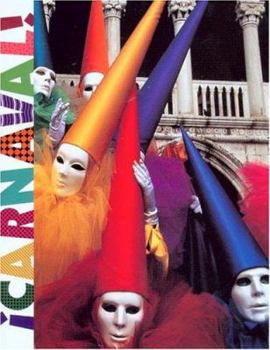
Carnaval, Fasnacht, Entroido, Carnival--the annual pre-Lenten festival most people in the United States know as Mardi Gras is celebrated in cities and rural villages throughout Europe and the Americas. With more than 300 dazzling photographs, this book offers an international look at Carnival in New Orleans and Basile, Louisiana; Laza, Spain; rural Bulgaria; Venice, Italy; Basel, Switzerland; Tlaxcala, Mexico; Oruro, Bolivia; Recife and Olinda, Brazil; Port of Spain, Trinidad and Tobago; and Port-au-Prince, Haiti. Carnival takes similar shapes everywhere European Catholics carried their religion and its festivals. People disguise or adorn themselves in costumes and masks to parade through the streets, eating, drinking, and making music before the Lenten fast begins on Ash Wednesday. But as this book shows, indigenous customs with even deeper roots--and, in many places, customs that accompanied enslaved Africans in their diaspora--became integrated into the festival to give it distinctive local flavors. In the four rural sites (Laza, southeastern Bulgaria, Basile, and Tlaxcala) many festival rituals are meant to promote the fertility of crops, livestock, and people. In the urban Carnivals of Oruro, Recife and Olinda, Port of Spain, Port-au-Prince, and New Orleans, Carnival groups compete through ingenious masquerades and spectacular performances. Venice's Carnival--a late-twentieth-century revival--is modeled on elite urban celebrations of the Renaissance, and Basel's--one of very few Carnivals to survive among European Protestants after the Reformation--involves large, organized troupes who wear masquerades portraying themes of social and political satire. In Haiti, Mardi Gras celebrations are deeply politicized and have even played a role in overturning governments.The contributors to this book take readers on a colorful journey through Carnival in these eleven far-flung places, outlining the history of Carnival in each area and its present form. The major masquerades are introduced--from Venice's classic Harlequin and Pierrot to Bulgaria's "Kouker" and Port of Spain's "Midnight Robber"--along with the kinds of groups who participate, such as Recife and Olinda's African "nations" and Tlaxcala's charro dancers. The sequence of Carnival events in each location is described, from excited preparation to last-gasp revelry, with tastes of festival food and drink and the rhythm of music along the way. Whatever deeper religious or civic significance Carnival may hold for its participants, it is always a time of play, conviviality, and fantasy--a time when alternatives to the status quo can be imagined and people can feel unleashed from everyday restraints. This book is a joyous celebration of this many-faceted festival and a tribute to those who have kept their Carnival traditions alive.
Format:Hardcover
Language:English
ISBN:0295984260
ISBN13:9780295984261
Release Date:October 2004
Publisher:University of Washington Press
Length:352 Pages
Weight:0.75 lbs.
Dimensions:11.3" x 1.3" x 8.8"
Customer Reviews
2 ratings
Carnaval Review
Published by Thriftbooks.com User , 19 years ago
This book is fantastic! It covers Carnival celebrations from all over the world. The history is detailed but not dull, and the pictures are vibrant and lively. I recommend this book to anyone that has been to (or wants to attend) a Carnival celebration and anyone that is interested in the stories/histories of the celebrations.
¡Carnival! Delights and Amazes
Published by Thriftbooks.com User , 20 years ago
In the forward to the vibrant, sumptuous and well-researched ¡Carnival!, Joyce Ice, Director of the Museum of International Folk Art (MOIFA), notes that festivals "as cultural phenomena never fail to intrigue and captivate us as human beings, whether we are casual observers, researchers, or participants." Edited by Barbara Mauldin, curator of Latin American folk art at MOIFA, ¡Carnival! does indeed intrigue and captivate as we are plunged-through essays, photographs and illustrations-into the fascinating and diverse celebration of this important and lively Christian festival. ¡Carnival! focuses on communities in Spain, Mexico, Switzerland, Haiti, Bulgaria, Italy, the United States, Bolivia, Brazil, Trinidad and Tobago. A varied and highly-qualified stable of historians, folklorists, anthropologists, linguists and curators offer well-researched and insightful essays that demonstrate how one festival could evolve into wonderfully diverse (yet similar) pre-Lenten celebrations. Colorful photographs and illustrations capture the sizzle and sass of the parades and costumes that take center stage in each of the cultures represented in this book. ¡Carnival! was almost a decade in the making and it shows. Meticulous yet soulful, scholarly yet enchanting, ¡Carnival! delights and amazes as much as it reminds us of the astonishing diversity of the world's cultures. [The full review first appeared in Southwest BookViews.]
Copyright © 2026 Thriftbooks.com
Terms of Use | Privacy Policy | Do Not Sell/Share My Personal Information | Cookie Policy | Cookie Preferences | Accessibility Statement
ThriftBooks ® and the ThriftBooks ® logo are registered trademarks of Thrift Books Global, LLC
ThriftBooks ® and the ThriftBooks ® logo are registered trademarks of Thrift Books Global, LLC
