


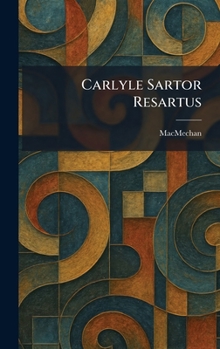
Carlyle Sartor Resartus

"Carlyle Sartor Resartus" stands as one of the most idiosyncratic and influential works of the nineteenth century. Part philosophical treatise, part social satire, and part spiritual autobiography, Thomas Carlyle's masterpiece explores the life and thought of the fictional German philosopher Diogenes Teufelsdr ckh. The central conceit of the work is the "Philosophy of Clothes," a metaphysical framework suggesting that all social institutions, religious creeds, and physical forms are merely external garments covering a deeper, spiritual reality.
Through the voice of an anonymous English editor trying to make sense of Teufelsdr ckh's chaotic papers, the reader is guided through a profound psychological journey from the "Everlasting No" to the "Everlasting Yea." This transformation marks a transition from existential despair and doubt to a state of spiritual affirmation and purpose. Edited with scholarly insight by Archibald MacMechan, this version provides the necessary context to navigate Carlyle's dense, innovative prose and multifaceted allusions. "Sartor Resartus" remains a foundational text for understanding the Victorian era, bridging the gap between Romantic idealism and the industrial modern age while critiquing the secularization of society.
This work has been selected by scholars as being culturally important, and is part of the knowledge base of civilization as we know it. This work was reproduced from the original artifact, and remains as true to the original work as possible. Therefore, you may see the original copyright references, library stamps (as most of these works have been housed in our most important libraries around the world), and other notations in the work.
This work is in the public domain in the United States of America, and possibly other nations. Within the United States, you may freely copy and distribute this work, as no entity (individual or corporate) has a copyright on the body of the work.
As a reproduction of a historical artifact, this work may contain missing or blurred pages, poor pictures, errant marks, etc. Scholars believe, and we concur, that this work is important enough to be preserved, reproduced, and made generally available to the public. We appreciate your support of the preservation process, and thank you for being an important part of keeping this knowledge alive and relevant.
Customer Reviews
ThriftBooks ® and the ThriftBooks ® logo are registered trademarks of Thrift Books Global, LLC
