


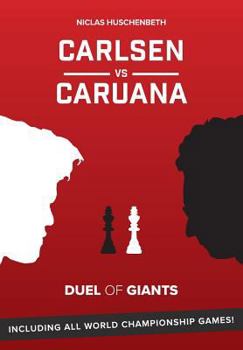
Carlsen vs. Caruana: Duel of Giants

Select Format
Select Condition 
Book Overview
The rivalry of reigning World Champion Magnus Carlsen and Fabiano Caruana began 2010 in the Dutch village Wijk aan Zee and culminated in the World Chess Championship 2018. Over the past years, they have crossed swords 71 times: In classical, rapid and blitz chess. All their games against each other - including the thrilling World Championship match - are thoroughly annotated in this book.
GM Niclas Huschenbeth gives detailed move-to-move explanations and decodes the complexities of the game, with the aim to improve the reader's chess understanding. After all, what could be better suited to enhance one's understanding than to study the games of the two best chess players on the planet?
From the introduction:
What You Will Learn From This Book
Have you ever played through a top level chess game and asked yourself "Why in the world did he play that move?" or "This move does not make any sense, what's the idea behind it?" If so, I can completely sympathize.
"Learn from the best. Analyze their games. Understand what they are doing and how they are doing it." These were the words of my coach when I was in my youth, aspiring to become a good player myself.
And I did. Or rather, I tried. All too often, though, I found myself scratching my head when playing through the games of Kasparov, Kramnik & Co. What was the idea behind this move? Why didn't he play that move instead? Back then, the computers were too weak to be of any help. These days, they are a bit more useful. They tell you the best move and the correct evaluation. But they still do not tell you why.
It's like trying to work out a difficult math problem and then just being shown the final solution. No learning happens. I was lucky to have my coach guide me through the jungle that chess often is. But not everybody is so fortunate to have a great coach. This is why I wrote this book. In this book, I decode the sometimes mysterious moves and explain the ideas behind them.
To me, chess boils down to two basic skills: understanding and calculation. Finding the right plans and finding ways to execute them - the two go hand in hand. But in training, we often compartmentalize, focusing on one specific topic, let's say "how to play with the bishop pair" or "good knight vs. bad bishop".
But chess does not work like that. After all, the beautiful thing about chess games is that you usually have some elements of everything. This is why I always found game analyses to be the most rewarding. You learn about chess as a whole and not about one specific detail. It is not without reason that about every coach recommends the study of one's own games as well as the games of the very best.
Related Subjects
GamesCustomer Reviews
ThriftBooks ® and the ThriftBooks ® logo are registered trademarks of Thrift Books Global, LLC
