


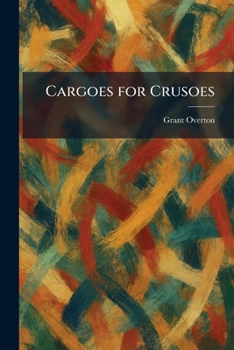
Cargoes for Crusoes

Select Format
Select Condition 
Book Overview
"Cargoes for Crusoes" is a captivating exploration of the literary landscape of the early 1920s, crafted by the insightful critic Grant Overton. Functioning as both a guide and a celebration of contemporary writing, the work addresses the "Crusoes" of the world-readers seeking intellectual and imaginative sustenance-by presenting them with a rich "cargo" of authors and their stories.
Overton provides in-depth profiles and critical evaluations of prominent writers of his time, including Philip Gibbs, Melville Davisson Post, Jeffery Farnol, and E. Temple Thurston. The book delves into the creative processes, personal backgrounds, and thematic preoccupations that defined these literary figures. Beyond individual portraits, the work offers broader reflections on the state of the book trade, the evolving tastes of the public, and the enduring power of storytelling.
With its blend of biography, bibliography, and literary appreciation, "Cargoes for Crusoes" serves as an invaluable resource for understanding the literary trends and publishing culture of the post-World War I era. Overton's engaging prose invites readers to rediscover forgotten gems and gain a deeper perspective on the writers of his generation, making it an essential read for book lovers and historians of literature alike.
This work has been selected by scholars as being culturally important, and is part of the knowledge base of civilization as we know it. This work was reproduced from the original artifact, and remains as true to the original work as possible. Therefore, you may see the original copyright references, library stamps (as most of these works have been housed in our most important libraries around the world), and other notations in the work.
This work is in the public domain in the United States of America, and possibly other nations. Within the United States, you may freely copy and distribute this work, as no entity (individual or corporate) has a copyright on the body of the work.
As a reproduction of a historical artifact, this work may contain missing or blurred pages, poor pictures, errant marks, etc. Scholars believe, and we concur, that this work is important enough to be preserved, reproduced, and made generally available to the public. We appreciate your support of the preservation process, and thank you for being an important part of keeping this knowledge alive and relevant.
Customer Reviews
ThriftBooks ® and the ThriftBooks ® logo are registered trademarks of Thrift Books Global, LLC
