


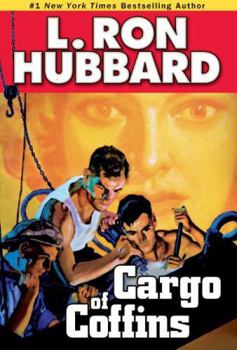
Cargo of Coffins

Select Format
Select Condition 
Book Overview
Lars Marlin has escaped from Devil's Island and come face to face with the man who put him there -- Paco Corvino. Now the two are off to sea serving on a luxury yacht. Lars is determined to find out... This description may be from another edition of this product.
Format:Paperback
Language:English
ISBN:159212352X
ISBN13:9781592123520
Release Date:July 2009
Publisher:Galaxy Press (CA)
Length:136 Pages
Weight:0.50 lbs.
Dimensions:0.5" x 5.5" x 8.0"
Age Range:10 to 13 years
Grade Range:Grades 5 to 8
Customer Reviews
1 rating
An entertaining gem from the Golden Age!
Published by Thriftbooks.com User , 16 years ago
I read L. Ron Hubbard's "Brass Keys to Murder" and "Cargo of Coffins" back to back and reveled in his mastery of pacing and characterization. Originally published in 1935 and 1937, both tales are now available as part of the Galaxy Press "Stories from the Golden Age" series. It's important to note that Hubbard was restricted by space limitations when these stories made their appearance prior to World War II. With that said, Hubbard managed to exploit the "short novel" (or novella) with his pacing. "Brass Keys to Murder" and "Cargo of Coffins" are crime novels not unlike those great Warner Brothers gangster films of the late 30s. I could easily imagine a George Raft or Humphrey Bogart roaming through a gloomy set as the action unfolds. And this is another aspect of Hubbard's writing that fascinates me, i.e., his timeliness and his apparently intuitive grasp of structure. He always seems to know precisely when a gunshot should happen or when a fistfight should break out. And his characters all embody the era when these stories were published. These are hardboiled little gems. In "Cargo of Coffins" you'll find lines like: "He examined his .38 and found it in good order. He slid it into his waistband and smoothed his crisp white jacket over the bulge it made." Similarly, in "Brass Keys to Murder" he describes the hero, Steve Craig, in this fashion: "His jaw was as square as a clipper's mainsail and his eyes were the shade of an arctic sea." He uses simile and sharp images to establish his characters and to set the scene. This is a talent lost to many of today's successful but less talented writers. And because these stories were intentionally short - he often published in a magazine called "Five Novels Monthly" - the pacing leaves one nearly breathless. Hubbard used his mastery of pacing to good effect throughout his career and I couldn't help but recall how superbly he demonstrated this skill in "Battlefield Earth" which clocks in at over 1,000 pages in paperback. There's not a dull page to be found in "Battlefield Earth." But that masterpiece was still well over forty years in the future when Hubbard penned "Brass Keys to Murder" and "Cargo of Coffins." These Galaxy Press reprints are wonderful and I hope they found the audience they deserve. Hubbard's legacy is assured. He stands beside Ray Bradbury, Lester Dent, Walter B. Gibson, H. P. Lovecraft, Robert E. Howard and Edgar Rice Burroughs as one of the American Masters from the glorious Golden Age.
Copyright © 2026 Thriftbooks.com
Terms of Use | Privacy Policy | Do Not Sell/Share My Personal Information | Cookie Policy | Cookie Preferences | Accessibility Statement
ThriftBooks ® and the ThriftBooks ® logo are registered trademarks of Thrift Books Global, LLC
ThriftBooks ® and the ThriftBooks ® logo are registered trademarks of Thrift Books Global, LLC
