


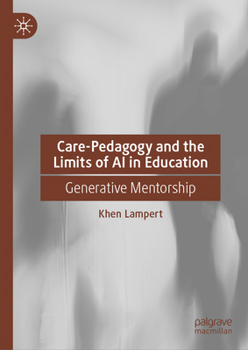
Care-Pedagogy and the Limits of AI in Education: Generative Mentorship

This book offers a philosophically precise account of what artificial intelligence cannot provide in education. Beginning from the premise of a fully optimized AI school that exceeds human institutions across all measurable domains, Khen Lampert identifies a constitutive absence: the event through which a child comes to matter to a particular other. He terms this event enworlding and distinguishes it from empathy or affirmation as a condition for the emergence of subjectivity. Drawing on phenomenology, psychoanalysis, and critical theory, the book argues that such encounters require finitude, vulnerability, and the capacity to be affected--conditions unavailable to artificial systems. Situating contemporary AI within a longer genealogy of the "ego-less" servant, Lampert reframes debates on educational technology as fundamentally ontological and political, challenging prevailing assumptions about care, relationality, and the aims of education. Against this background the book develops its constructive answer, generative mentorship: the educational encounter in which an adult's finite, non-demanding presence generates a child's sense of mattering to a particular other--a model no artificial system can instantiate, and no education can do without.
Customer Reviews
ThriftBooks ® and the ThriftBooks ® logo are registered trademarks of Thrift Books Global, LLC
