


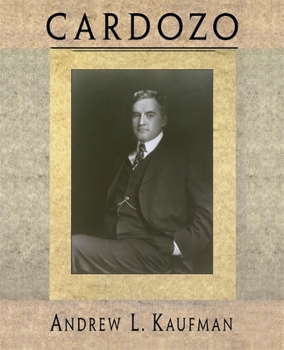
Cardozo

Select Format
Select Condition 
Book Overview
Benjamin Nathan Cardozo, unarguably one of the most outstanding judges of the twentieth century, is a man whose name remains prominent and whose contributions to the law remain relevant. This first complete biography of the longtime member and chief judge of the New York Court of Appeals and Justice of the Supreme Court of the United States during the turbulent years of the New Deal is a monumental achievement by a distinguished interpreter of constitutional law.
Cardozo was a progressive judge who understood and defended the proposition that judge-made law must be adapted to modern conditions. He also preached and practiced the doctrine that respect for precedent, history, and all branches of government limited what a judge could and should do. Thus, he did not modernize law at every opportunity. In this book, Andrew Kaufman interweaves the personal and professional lives of this remarkable man to yield a multidimensional whole. Cardozo's family ties to the Jewish community were a particularly significant factor in shaping his life, as was his father's scandalous career--and ultimate disgrace--as a lawyer and judge. Kaufman concentrates, however, on Cardozo's own distinguished career, including twenty-three years in private practice as a tough-minded and skillful lawyer and his classic lectures and writings on the judicial process. From this biography emerges an estimable figure holding to concepts of duty and responsibility, but a person not without frailties and prejudice.Format:Paperback
Language:English
ISBN:0674001923
ISBN13:9780674001923
Release Date:April 2000
Publisher:Harvard University Press
Length:744 Pages
Weight:2.55 lbs.
Dimensions:1.6" x 6.3" x 9.2"
Customer Reviews
5 ratings
An excellent (and not too technical) book for those with training in law.
Published by Thriftbooks.com User , 15 years ago
CARDOZO by Andrew L. Kaufman is 731 pages long. There are eight pages of non-glossy black and white photos, showing Benjamin Cardozo as a boy (with prominent chin) and as a young man (with an even bigger chin, like Jay Leno's chin). Chapter 2 discloses that Benjamin Cardozo was born on May 24,1870, along with a twin sister, to Albert (father) and Rebecca (mother). The father, an attorney, had been admitted to the bar in 1849. When Benjamin was nine his mother died (page 21). The book provides us with one of Ben's childhood poems, which concerned sprits and dreams. Chapter 4 discloses Benjamin Cardozo's early years as an attorney. He was admitted to the bar on Oct. 26, 1891 (page 54), and his first case was Frank v. Davis (1891), which concerned real estate. The heart of the book resides in Chapters 14-16 (pages 243-312). These chapters concern tort law. We learn that Mr.Cardozo joined the New York Court of Appeals (equivalent to a state supreme court) in 1914. One by one, the author provides sketches of various important tort cases, such as Kettell v. Erie (injured passenger), Caruso v. Steamship (anthrax germs in cotton), Dougherty v. Pratt (window washter), MacPherson v. Buick (broken spokes), O'Connor v. Webber (butcher shop accident), Wagner v. International (rescuing a man who fell off a train), and of course Palsgraff v. Long Island (Italian fireworks). Law students, as well as seasoned attorneys, will savor every word of these chapters, when they are reminded of some of the origins of concepts such as standard reasonable man, assumption of risk, proximate cause, foreseeable risk, and whether a victim is a "likely" victim or an "unlikely" victim. The author provides a small amount of information of the case law from England, as it applies to torts. (But this reader would have liked to have seen a more comprehensive disclosure of the earlier English case law relating to torts.) Chapter 23 (page 455-471) informs us that Mr.Cardozo was on the N.Y. Court of Appeals for 18 years and then, at age 61, was appointed to the U.S.Supreme Court, replacing Oliver Wendell Holmes. Mr. Learned Hand (well-known to all law students) was also a candidate for this post, but was not seriously considered, because of his political liabilities (the reader is left hanging as to the nature of these liabilities). Chapter 24 (page 472-490) discloses Mr.Cardozo's life in Washington, D.C., e.g., the furniture in his apartment, his loneliness for his earlier social life in New York, his work habits (7 am to 11 pm), the contrast between the collegial judges back at the N.Y. Court of Appeals and the more independent work habits of the U.S. Supreme Court justices, the contrast between the passionate social activism of Justice Brandeis and the relative detachment of Mr.Cardozo. We learn that Mr.Cardozo was a friend of Fred Coudert, of Coudert Brothers law firm. (This reviewer was a patent agent with Coudert Brothers, a year before the law firm went under
The Definitive Biography
Published by Thriftbooks.com User , 19 years ago
Professor Kaufman worked on this impressive biography of Benjamin Nathan Cardozo for over 35 years. There were times when one began to wonder if it would ever appear. Well, it did and it was worth the wait. This is a long book, running some 700 pages including notes. At times, it seems almost too detailed--but it is a wonderful resource for anyone interested in Cardozo, the development of American law, and the Supreme Court. Kaufman strikes a nice balance between BNC's private and public lives, his 18 year service on the New York Court of Appeals and his 5 or so terms on the Supreme Court, the biographical details one expects and the legal doctrines and opinions that he authored. Along the way, the author covers BNC's significant books; his involvement with the ALI; his work in developing key contract and tort concepts on the Court of Appeals; his long period as Chief Judge there; and his methods of working and drafting opinions while on the New York court. It is generally conceded that Cardozo's greatest contributions to the development of American law occurred on the CA and not during his service on the Supreme Court--he was the master common law judge rather than constitutional expert. So Kaufman devotes around 300 pages to Cardozo's service on that court. By contrast, around 100 pages are devoted to the Supreme Court and BNC's period in Washington. In fact, BNC does not get appointed until page 455. Cardozo found the Supremes a much less collegial body than the NY Court, in part because the justices were still doing the bulk of their work at home. Cardozo's views of state regulatory power and taxation, national regulatory power, court packing, and some civil liberties cases (such as Palko) are well addressed. Cardozo must have found it difficult to deal with colleagues such as Justice McReynolds and the other "four horsemen," but nonetheless he opposed FDR's court packing scheme. While Richard Polenberg's "World of Benjamin Cardozo" (also published by Harvard University Press) is itself a fine contribution, this is the most exhaustive study of Cardozo that we are likely ever to see. It is a masterful work, but one that requires persistence to get through. It is the book that BNC deserves.
Extraordinary insights into an American judicial hero
Published by Thriftbooks.com User , 27 years ago
Andrew Kaufman has written an engrossing account of the life of Benjamin Cardozo, a judicial hero of the first third of the century. This book should prove especially useful for first-year law students, who read many of Cardozo's most important decisions in their contracts and torts classes. But even non-lawyers with an interest in the legal system will find it highly readable and informative.
An honest and insightful biography of a pivotal figure
Published by Thriftbooks.com User , 27 years ago
Professor Kaufman presents his subject, first, as a man, establishing the personal background that shaped Cardozo's work as a judge. Kaufman then offers an insightful examination of the judicial work of Judge and Justice Cardozo, analyzing the development and maturation of Cardozo's thinking regarding the many legal principles which have become mainstays of American jurisprudence. The biography is well suited to lawyer and non-lawyer, and provides an extraordinary social history of the shaping of the American common law that governs our lives and liability today. This biography is a must-read primer for all soon-to-be law students, who will find in it an invaluable guide to the principles they are preparing to study. Professor Kaufman's honest analysis of the talents and faults of his subject is much to be commended.
The only comprehensive biography of Justice Cardozo
Published by Thriftbooks.com User , 27 years ago
This is a book for laypeople and lawyers, rare in judicial biography. It is written in a clear and lucid prose, eschewing much of the current academic jargon. The author's years of work include many interviews with people now dead (and thus unavailable!), providing invaluable insights and perspectives into Cardozo's life and judicial influence. This work will be interesting to social historians, as well, for its treatment of the Nathan and Cardozo families' experiences in an evolving America.
Copyright © 2026 Thriftbooks.com Terms of Use
| Privacy Policy | Do Not
Sell/Share My Personal Information | Cookie Policy | Cookie Preferences | Accessibility Statement
ThriftBooks® and the ThriftBooks® logo are registered trademarks of Thrift Books Global, LLC
ThriftBooks® and the ThriftBooks® logo are registered trademarks of Thrift Books Global, LLC
