


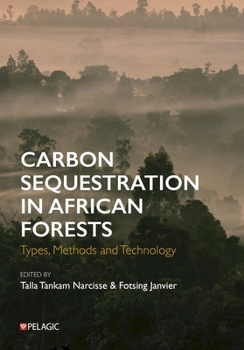
Carbon Sequestration in African Forests: Types, Methods and Technology
No Customer Reviews

This book offers in-depth coverage of the process of climate change management in African forests, from assessment of woody species diversity to climate change mitigation, including carbon sequestration capacity and carbon taxation. Going beyond merely demonstrating the importance of vegetation in carbon sequestration, the volume also helps in quantifying the contribution of various species in the process. Focused on tropical vegetation in Africa, specifically the Congo Basin, novel approaches to carbon sequestration capacity and above-ground biomass assessment are presented. The latest methods are highlighted, including remote-sensing technologies, digital image processing and development of classification methodologies for various plants and the assessment of their use in carbon sequestration. The financial implications of different schemes are also discussed. Extensive case studies offer details on afforestation/reforestation; exploitation and conservation of forests in the context of REDD+; carbon taxation and capacity building; assessing carbon sequestered in mangrove forests; evaluation of marginal forests; and assessment methods based on allometric equations and a generalized coefficient. This book brings together the latest information to meet the needs of researchers and policymakers working at the cutting edge of carbon sequestration and climate change. This book offers in-depth coverage of the process of climate change management in African forests, from assessment of woody species diversity to climate change mitigation, including carbon sequestration capacity and carbon taxation. Going beyond merely demonstrating the importance of vegetation in carbon sequestration, the volume also helps in quantifying the contribution of various species in the process. Focused on tropical vegetation in Africa, specifically the Congo Basin, novel approaches to carbon sequestration capacity and above-ground biomass assessment are presented. The latest methods are highlighted, including remote-sensing technologies, digital image processing and development of classification methodologies for various plants and the assessment of their use in carbon sequestration. The financial implications of different schemes are also discussed. Extensive case studies offer details on afforestation/reforestation; exploitation and conservation of forests in the context of REDD+; carbon taxation and capacity building; assessing carbon sequestered in mangrove forests; evaluation of marginal forests; and assessment methods based on allometric equations and a generalized coefficient. This book brings together the latest information to meet the needs of researchers and policymakers working at the cutting edge of carbon sequestration and climate change.
Format:Hardcover
Language:English
ISBN:1784276162
ISBN13:9781784276164
Release Date:June 2026
Publisher:Pelagic
Length:168 Pages
Weight:1.05 lbs.
Dimensions:0.4" x 6.7" x 9.6"
Customer Reviews
0 rating
Copyright © 2026 Thriftbooks.com
Terms of Use | Privacy Policy | Do Not Sell/Share My Personal Information | Cookie Policy | Cookie Preferences | Accessibility Statement
ThriftBooks ® and the ThriftBooks ® logo are registered trademarks of Thrift Books Global, LLC
ThriftBooks ® and the ThriftBooks ® logo are registered trademarks of Thrift Books Global, LLC
