


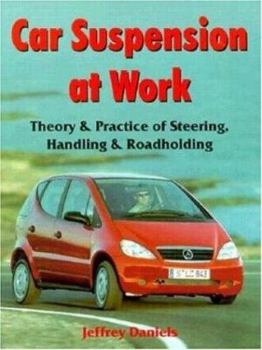
Car Suspension at Work : Theory & Practice of Steering, Handling & Roadholding

This is a book which, in a most readeable way, offers a better understanding of a car''s potential and its limitations whenever its suspension is put to the test.' This description may be from another edition of this product.
Format:Paperback
Language:English
ISBN:1899870318
ISBN13:9781899870318
Release Date:January 1998
Publisher:Motorbooks Intl
Length:168 Pages
Weight:1.15 lbs.
Dimensions:10.0" x 0.5" x 7.5"
Customer Reviews
4 ratings
Excellent source for the non-engineer.
Published by Thriftbooks.com User , 19 years ago
What really sets this book apart is the approach: a clear and concise guide to various suspension systems that remains objective through every discussion. The language is technical enough to convey appropriate meaning, yet examples are clear enough that you can understand what's going on even if your diploma doesn't include the word "engineer." There's a bit of unnecessary repetition, and the author makes it quite clear that designers and engineers are usually at odds. But if you get around this (and learn when to skip a paragraph or two), you'll find a book that's surprisingly easy to read (given the subject matter) and thoughtful in its execution.
Best introduction
Published by Thriftbooks.com User , 20 years ago
The author is an experienced auto journalist, a former aeronautical engineer, and a free-lance test driver, so is well equipped to introduce the average reader to the theory and practice of suspensions. He begins with basics: slip angles, oversteer, and so on, all properly described in engineering terms but never oppressively so. Then separate chapters focus on FWD, RWD, AWD and end with a look back on some modern landmark designs, like the Jaguar E-type or the VW Rabbit. We learn struts and double wishbone are the two choices up front; the rear adds multilink and torsion beam. Nowadays independent rear suspensions are the norm, the last solid axle design being the Saab 9000. And the wide tires and mid-engine designs, while fine for powerful Formula One cars, mean little elsewhere. Like his other books, the writing is engaging and informal, and is intended for a British audience, only adding to its charm.
Very good explanations
Published by Thriftbooks.com User , 25 years ago
I tried this book because I wanted some introduction on car suspensions. Also I needed some some basics to help me on designing my own car suspension. I found this book with a good general introduction to what's already done, explanations for basics, principles and definitions, and full chapters talking about tyres, steering, handling, etc. It gives clear concepts and examples on the equations used to design and demonstrate what suspensions are about. In General, I found it with good examples, very well organized and by the way, Great pictures and diagrams. Good book!
Fundamentals of vehicle dynamics easy to understand
Published by Thriftbooks.com User , 27 years ago
If your looking for a book that can explain how various suspension designs and characteristics can effect the dynamics of motor vehicles this is for you.You don't have to be an engineer to follow the concepts. An excellent starting point for budding automotive engineers. The book only lacks in not taking it to the next step, looking at specific setups with precise specifications, even as a case study.To be fare though, the book does not set out to do this, but does extremely well what it does aim at - Giving an understanding of the concepts, pros and cons of most common auto suspension and drivetrain arrangements.
Copyright © 2026 Thriftbooks.com Terms of Use
| Privacy Policy | Do Not
Sell/Share My Personal Information | Cookie Policy | Cookie Preferences | Accessibility Statement
ThriftBooks® and the ThriftBooks® logo are registered trademarks of Thrift Books Global, LLC
ThriftBooks® and the ThriftBooks® logo are registered trademarks of Thrift Books Global, LLC
