


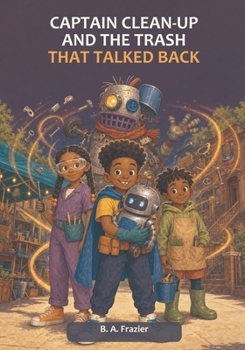
Captain Clean-Up and the Trash That Talked Back
No Customer Reviews

Captain Clean-Up and the Trash That Talked Back is a full-color graphic early reader for children ages five through eight. It combines the forward motion of a superhero comedy with the emotional truth of a child trying to hide an unfinished mistake. The story is designed for independent early readers, supported reading, classroom use, family read-alouds, and repeat visual discovery. Its environmental ideas are carried by character decisions and comic action, not by a detached lecture. At the center of the book is a simple question children understand immediately: when something looks broken, unwanted, or out of place, is throwing it away really the only answer?Eight-year-old Malcolm Price is imaginative, energetic, and certain that his messy bedroom is not a mess at all. It is Captain Clean-Up Headquarters, a place where inventions are waiting, plans are forming, and every object might become part of a future mission. Malcolm's mother, Alicia, respects his imagination while setting a clear and loving boundary: a real headquarters still needs a safe path across the floor. Malcolm is supposed to sort the room before the approaching storm arrives. Instead, he chooses a shortcut. He stuffs clothing, toys, paper, jars, repairable parts, and unfinished projects into one enormous purple laundry basket and calls the job complete.The storm disagrees. A strange spark reaches the mixed-up pile, and the Heap wakes with an amber flashlight eye, a blue button eye, a purple basket mouth, striped sock fingers, a cracked lampshade shoulder, and a bent scooter wheel at its side. The Heap is funny, loud, and startling rather than frightening. It has a rhythm children can anticipate and join: "Thrown away? Come my way " Once it escapes onto Alder Street, every carelessly discarded object seems to answer. Loose paper, a safe can, a forgotten sock, and ordinary bags of household trash swirl toward it. The Heap grows because everything has been given the same name and the same destination.Malcolm reacts as a child hero would. He ties on a cobalt towel cape, straps on an orange cardboard utility belt, pulls on teal work gloves, and tries to take command. His first solution is direct, dramatic, and completely wrong: find a bigger bin and throw the whole problem away. The Heap loves that plan. Two more bags make it tower over the sidewalk, and Malcolm has to confront the difference between looking heroic and solving the actual problem.Help arrives through partnership rather than rescue. Keisha Grant, a mechanically gifted nine-year-old neighbor, studies the Heap as a system. She notices that its body is made of objects with different conditions and different possible futures. Noah Price, Malcolm's six-year-old brother, understands soil, food scraps, leaves, and the importance of keeping plastic out of compost. Alicia remains nearby as a caring adult who watches the children work safely, but she does not take over their mission. The children form a team because each one knows something the others need.Together they replace the one-pile shortcut with five clear next-place routes. Teal means repair. Orange means reuse. Sky blue means recycle after checking local rules. Violet means share or donate clean, complete, usable items. Green means compost suitable food scraps and yard material. The system is visually memorable without pretending that every community accepts the same materials. When a questionable black plastic lid appears, Keisha does not guess. She checks local collection guidance. When a shiny wrapper approaches the compost tumbler, Noah stops it. These details allow the book to model thoughtful habits while staying honest about the limits of a universal recycling rule.
Format:Paperback
Language:English
ISBN:B0HCX7HQCZ
ISBN13:9798349471964
Release Date:August 2026
Publisher:Bright Moon Books
Length:50 Pages
Weight:0.30 lbs.
Dimensions:0.1" x 7.0" x 10.0"
Age Range:5 to 8 years
Grade Range:Preschool to Grade 3
Customer Reviews
0 rating
Copyright © 2026 Thriftbooks.com
Terms of Use | Privacy Policy | Do Not Sell/Share My Personal Information | Cookie Policy | Cookie Preferences | Accessibility Statement
ThriftBooks ® and the ThriftBooks ® logo are registered trademarks of Thrift Books Global, LLC
ThriftBooks ® and the ThriftBooks ® logo are registered trademarks of Thrift Books Global, LLC
