


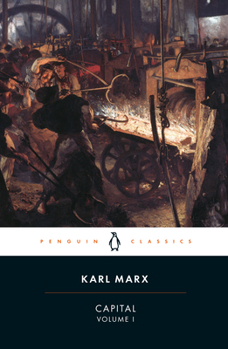
Capital: A Critique of Political Economy, Volume 1
(Part of the Capital (#1) Series, Das Kapital Manga (#1) Series, and Karl Marx, Frederick Engels: Collected Works (#35) Series)


Select Format
Select Condition 
Book Overview
The first volume of a political treatise that changed the world One of the most notorious works of modern times, as well as one of the most influential, Capital is an incisive critique of private property and the social relations it generates. Living in exile in England, where this work was largely written, Marx drew on a wide-ranging knowledge of its society to support his analysis and create fresh insights. Arguing that capitalism would cause an ever-increasing division in wealth and welfare, he predicted its abolition and replacement by a system with common ownership of the means of production. Capital rapidly acquired readership among the leaders of social democratic parties, particularly in Russia in Germany, and ultimately throughout the world, to become a work described by Marx friend and collaborator Friedrich Engels as "the Bible of the working class." For more than seventy years, Penguin has been the leading publisher of classic literature in the English-speaking world. With more than 1,700 titles, Penguin Classics represents a global bookshelf of the best works throughout history and across genres and disciplines. Readers trust the series to provide authoritative texts enhanced by introductions and notes by distinguished scholars and contemporary authors, as well as up-to-date translations by award-winning translators.
Format:Paperback
Language:English
ISBN:B01EKIFWVE
ISBN13:9780140445688
Release Date:May 1992
Publisher:Penguin Classics
Length:1152 Pages
Weight:1.61 lbs.
Dimensions:2.1" x 5.0" x 8.1"
Age Range:18 years and up
Grade Range:Postsecondary and higher
Customer Reviews
5 ratings
A highly detailed and comprehensive body of work!
Published by Trevor , 2 years ago
This book is not very big at all, but the pages are chock full of wisdom and information. It’s an impressive book, and very well researched. A book that will stick with you and be a source of an economic enlightenment.
“In reality, the laborer belongs to capital before he has sold himself to capital. His economic bondage is both brought about and concealed by the periodic sale of himself, by his change of masters, and by the oscillation in the market price of labor power. Capitalist production, therefore, under its aspect of a continuous connected process, of a process of reproduction, produces not only commodities, not only surplus value, but it also produces and reproduces the capitalist relation; on the one side the capitalist, on the other the wage-laborer.“
Doors of Perception
Published by Thriftbooks.com User , 19 years ago
If : - Your mum has taught you lots of valuable things (eat your vegetables, be nice to old people and little dogs, don't be late to school, keep a clean nose) but she was never really able to explain why you had to WORK for a living - instead of, you know, just living; - Your teachers packed your head full with all kinds of useful knowledge (about prepositions and adverbs, mineralogy and astrophysics, the reproductive organs of plants, x+2-y=0) but they never told you how exactly PROFITS are made - and why anybody would want to make them anyway; - Your friends and lovers can spend hours yakking about various interesting topics (the latest music machine, videogames, designer shoes, imitation leather sofas, blockbuster movies, pink underwear and cherry flavoured bubble-gum) but they call you a bore and a nitpick whenever you wonder why you're all surrounded by so many COMMODITIES and publicity ads promising you bigger, better and faster useless things. - You often have the impression that some greater truth is lacking in your life (and you've tried all the legal/illegal drugs, exciting TV shows, gurus and psychoanalysts, help-yourself books and bestsellers about kid sorcerers)... ...Then the time may have come to have a long talk with good old Uncle Karl - the black sheep of the social sciences, the guy nobody likes to mention at social occasions (except in the form of a joke: "have you heard the one about Karl Marx in Las Vegas?"), the most misquoted and misinterpreted modern thinker. In "Capital", he kindly invites you to break on through to the other side (that's how countercultural he was) and check out what's really happening behind the glitzy appearances of everyday life. You don't even have to be a genius to understand him (it will be enough if you can count to ten without choking). And you might be surprised about how obvious some things will seem after he explains to you about the cage you're sitting in. Of course, mum will probably be broken-hearted and fear that you'll join the next anarcho-pinko-terrorist organization down the block. Your teachers might refer to a vast list of successful anti-Marx books and charity organizations. And your friends and lovers will find you an even greater bore than before.
Seeing in the Fifth Dimension
Published by Thriftbooks.com User , 21 years ago
I think it was the poor French philosopher Althusser who claimed that Marx had discovered a new continent of thought called "history" equivalent to the continents of thought discovered by Pythagoras (geometry) and Aristotle (science). I would use a different metaphor. It is as if Marx invented a pair of x-ray glasses that allows you the viewer to see the exploitation hidden in every commodity, no matter how beautifully it is packaged. I guess the only book it is really comparable to would be the Bible, edited and created in the year 207 by the North African Roman citizen Quintus Septimius Florens Tertullianus. On the narrative level the books are quite opposite. The one starts with a single savior who comes to save the world, but ends up being exploited, abused and killed, thus needing saving, the other starts with a class that is exploited, abused and killed, but ends up saving the world. Of the two, Marx is definitely the more optimistic view. But if we could resurrect Marx as we resurrected Jesus, would he still have his optimism?
A good read for his time and for ours
Published by Thriftbooks.com User , 22 years ago
I would think that Marx has had both good and bad rep and that his detractors and fans have taken his legacy further than it deserved. So how should he be viewed? I submit that there are 4 ways to do so and all of them are mutually important. They are 1) Economic, 2) Intellectual, 3) Political and 4) Moral.Marx based his economic views on the premise that all value of a good produced comes from the labor that goes into it. Intuitively this seems wrong. What of the capital, management, demand (by the way Marx does not like the idea of supply and demand either) etc. Our experience shows that all of these and more play a role in determining what value a thing has. Iteratively the Marxist model of economy then suffers from its imperfect premise. His contention of lack of sustainable profits etc make sense if you agree with his premise but that is not how it shapes out in the modern World. All in all it seems that Marx misses the point about how economy works, and given his incredible intelligence, you wonder why.I think the reason is in the intellectual workings of his mind. Now it appears that most of human experience happens in shades of gray or on a spectrum. Very few things actually are definite "this or that". This is particularly true of psychology, sociology and also economics. Perhaps the very fact that so many variables come to bear on any given situation that it would be impossible to reproduce that situation again reliably. Hence much of these fields are understood along a spectrum and minor variation in observation is to be expected from event to event and from time to time. Unfortunately many people tend to think of the World as an absolute. For this, against that, regardless of the circumstances (abortion, death penalty, taxes etc come to mind). Marx takes the notion of value of labor from Adam Smith and particularly David Ricardo and fixates upon it as the only determinant of value of a good. Intellectually it boxes him in an inflexible position where he has to stick to his position. Eventually this inflexibility dooms him.Marx built upon his economic position to develop a political scenario that just did not happen - not sustainably. I think here the folly is not that the position was wrong but rather that when he makes his predictions: "....exploiters will be expropriated ...", he never says how it would come about. This would not be so bad if more of his writings actually had some sort of road map of how you get to this utopia, but they don't. Finally, is he as bad as I have made him out to be? Well, you be the judge. This is a man writing at the tail end of the initial experience of the industrial revolution. He devotes a large part of Capital to vivid descriptions of young children being dragged out of bed at 2 and 3 in the morning to work in horrible factories, of starving mothers giving up their children to horrendous working conditions in phosphorus match factories where they would die within a few years or were horribly affli
Tough but worthwhile
Published by Thriftbooks.com User , 23 years ago
Marx's CAPITAL is frequently condemned by people who've never read it, and lauded by other people who don't fully understand it. I've read it and I don't think I fully understand it, but the main points of the text are pretty clear; Marx drills them into the reader as he unfolds his theory of the basis of capitalism. First, a note on what CAPITAL is not. It is not a "communist" tract, though it is a foundation for communist thought. Marx follows two main trains of thought -- the first is observational, the second diagnostic. He explains how capitalism works, and why it works that way. Disagreeable as some of his ideas may be, they cannot be brushed away by citing the examples of Stalin and Pol Pot to discredit them. Unlike the typical Communist dictator, Marx was a hard-working scholar, a clear thinker, a fundamentally honest writer. His familiarity with the whole spectrum of economic and philosophical writings that preceded him is unquestionable, and CAPITAL is probably more impressive to a reader who's read THE WEALTH OF NATIONS (Adam Smith), if nothing else. The capitalism of Marx's time (mid-19th century) had dismal effects on the "proletariat" or working-class, and CAPITAL cannot be fully appreciated without some knowledge of how England, the most industrialized nation in the world, looked at that period of history. Charles Dickens is one writer who "exposed" the condition of the poor, in a more acceptable (though no less wordy) fashion it seems. CAPITAL is certainly an important book and it is not the unreadable monstrosity it's reputed to be. It is repetitious, but usually the repetition includes some new twist as Marx proceeds from one aspect of his theory to the next. The purpose of the book was to establish a scientific basis for his understanding of capitalism, so Marx employs numerous algebraic equations that might scare readers away at first. They are not complicated, however, nor are they really "mathematical" so much as illustrative of abstract economic processes. One quickly grows accustomed to them; I personally find them amusing. Marx's book is also a polemical text, and he injects some bitter wit and just plain nastiness into his analysis. Either he couldn't restrain himself, or it's a rhetorical device, but whatever the case, CAPITAL contains some very interesting screeds and some very memorable caricatures of capitalists. Overall a powerful book and one that promotes greater understanding of the forces that shape our world even today.
Copyright © 2026 Thriftbooks.com Terms of Use
| Privacy Policy | Do Not
Sell/Share My Personal Information | Cookie Policy | Cookie Preferences | Accessibility Statement
ThriftBooks® and the ThriftBooks® logo are registered trademarks of Thrift Books Global, LLC
ThriftBooks® and the ThriftBooks® logo are registered trademarks of Thrift Books Global, LLC
