


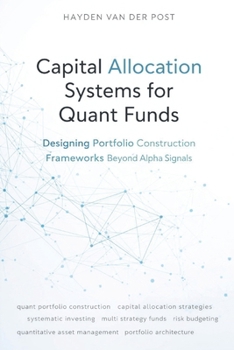
Capital Allocation Systems for Quant Funds: Designing Portfolio Construction Frameworks Beyond Alpha Signals

Most quantitative funds are built on signals. Fewer are built on systems.
While alpha generation receives the majority of attention, long-term performance is often determined by how capital is structured, deployed, and reallocated across strategies, regimes, and risk layers. The architecture that sits above signals is what ultimately governs resilience, scalability, and survival.
This book examines capital allocation as an engineered system rather than a secondary portfolio task.
It explores how modern quantitative funds can move beyond signal-centric thinking and design structured portfolio construction frameworks that integrate:
- multi-strategy capital routing
- regime-aware allocation layers
- dynamic risk budgeting
- structural diversification
- capital efficiency under volatility
- portfolio-level decision logic
Instead of treating allocation as a static optimization problem, the focus shifts toward building adaptive allocation infrastructure capable of operating across shifting market environments.
Designed for quants, portfolio architects, and systematic investors, this work presents a practical and conceptual approach to building allocation frameworks that sit above alpha generation and enable strategies to function cohesively inside a unified capital system.
The result is a portfolio that is not just predictive, but structurally durable.
Customer Reviews
ThriftBooks ® and the ThriftBooks ® logo are registered trademarks of Thrift Books Global, LLC
