


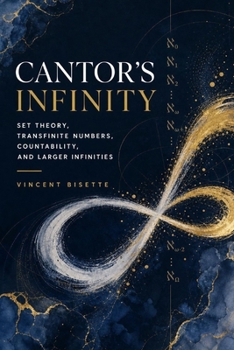
Cantor's Infinity: Set Theory, Transfinite Numbers, Countability, and Larger Infinities

Infinity is one of the most fascinating and counterintuitive ideas in mathematics. It appears simple at first, but once examined through set theory, numbers, and countability, it reveals a structure far richer than ordinary intuition suggests.
Cantor's Infinity introduces readers to the mathematical revolution created by Georg Cantor and his theory of infinite sets. The book explains how different sizes of infinity can exist, why some infinite sets are countable while others are not, and how transfinite numbers changed the foundations of modern mathematics.
Written for readers who want a clear and structured introduction, this book covers the essential ideas behind sets, mappings, one-to-one correspondence, countable infinity, uncountable infinity, cardinality, ordinal numbers, and the continuum. It avoids unnecessary abstraction while still preserving the conceptual precision needed to understand the subject properly.
Inside, readers will explore:
How set theory became a language for modern mathematics
Why infinite sets can be compared by size
The difference between countable and uncountable infinity
Cantor's diagonal argument and its lasting importance
The meaning of transfinite cardinal and ordinal numbers
How larger infinities challenged earlier mathematical assumptions
Why Cantor's ideas still shape logic, analysis, philosophy, and the foundations of mathematics
This book is suited for students, independent learners, teachers, and mathematically curious readers who want to understand infinity beyond simple paradoxes and popular explanations.
Cantor's Infinity offers a careful path into one of mathematics' deepest ideas: that infinity is not one thing, but an entire hierarchy of structures waiting to be understood.
Customer Reviews
ThriftBooks ® and the ThriftBooks ® logo are registered trademarks of Thrift Books Global, LLC
