


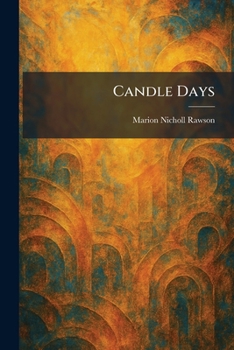
Candle Days

"Candle Days" offers a rich and evocative exploration of the domestic life and material culture of early America. Marion Nicholl Rawson provides an intimate look at the daily routines, tools, and craftsmanship that defined the era of the early settlers. From the art of candlemaking and weaving to the construction of simple household implements, the work serves as a comprehensive guide to the resourcefulness and ingenuity of the American pioneers.
Through detailed accounts of seasonal chores and the rhythms of the rural home, Rawson captures a vanishing way of life. The book delves into the significance of the hearth, the evolution of farm equipment, and the social customs that bound communities together. It is an essential resource for those interested in Americana, social history, and the practical skills of a bygone era. "Candle Days" preserves the wisdom of the past, celebrating the beauty of hand-wrought objects and the enduring spirit of self-sufficiency that shaped the American landscape. Readers will find a nostalgic yet scholarly tribute to the artifacts and traditions that formed the foundation of early American society.
This work has been selected by scholars as being culturally important, and is part of the knowledge base of civilization as we know it. This work was reproduced from the original artifact, and remains as true to the original work as possible. Therefore, you may see the original copyright references, library stamps (as most of these works have been housed in our most important libraries around the world), and other notations in the work.
This work is in the public domain in the United States of America, and possibly other nations. Within the United States, you may freely copy and distribute this work, as no entity (individual or corporate) has a copyright on the body of the work.
As a reproduction of a historical artifact, this work may contain missing or blurred pages, poor pictures, errant marks, etc. Scholars believe, and we concur, that this work is important enough to be preserved, reproduced, and made generally available to the public. We appreciate your support of the preservation process, and thank you for being an important part of keeping this knowledge alive and relevant.
Customer Reviews
ThriftBooks ® and the ThriftBooks ® logo are registered trademarks of Thrift Books Global, LLC
