


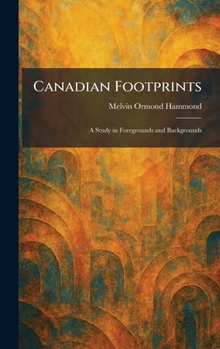
Canadian Footprints: A Study in Foregrounds and Backgrounds

"Canadian Footprints: A Study in Foregrounds and Backgrounds" is an evocative exploration of the historical and geographical landscapes that define the nation of Canada. Written by Melvin Ormond Hammond, this work functions as both a historical survey and a travel narrative, guiding the reader through the physical sites that have witnessed the country's most significant turning points. By examining the "foregrounds" of the present day against the "backgrounds" of the past, Hammond provides a unique perspective on how history is etched into the very soil and architecture of the land.
The narrative traverses various regions, documenting early settlements, significant battlefields, and the growth of urban centers. Hammond's prose brings a vivid sense of place to the historical record, illustrating the lives of the people who shaped the country's development. This work emphasizes the importance of preserving the memory of these sites, arguing that the Canadian landscape itself serves as a living monument to the nation's evolution. Readers will find a rich tapestry of anecdotes and descriptions that highlight the enduring connection between Canada's physical environment and its cultural heritage, making it an essential volume for those interested in the historical geography of North America.
This work has been selected by scholars as being culturally important, and is part of the knowledge base of civilization as we know it. This work was reproduced from the original artifact, and remains as true to the original work as possible. Therefore, you may see the original copyright references, library stamps (as most of these works have been housed in our most important libraries around the world), and other notations in the work.
This work is in the public domain in the United States of America, and possibly other nations. Within the United States, you may freely copy and distribute this work, as no entity (individual or corporate) has a copyright on the body of the work.
As a reproduction of a historical artifact, this work may contain missing or blurred pages, poor pictures, errant marks, etc. Scholars believe, and we concur, that this work is important enough to be preserved, reproduced, and made generally available to the public. We appreciate your support of the preservation process, and thank you for being an important part of keeping this knowledge alive and relevant.
Customer Reviews
ThriftBooks ® and the ThriftBooks ® logo are registered trademarks of Thrift Books Global, LLC
