


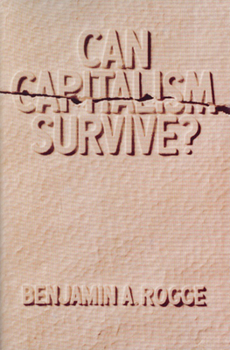
Can Capitalism Survive?

Select Format
Select Condition 
Book Overview
Benjamin A. Rogge--late Distinguished Professor of Political Economy at Wabash College--was a representative of that most unusual species: economists who speak and write in clear English. He forsakes... This description may be from another edition of this product.
Format:Hardcover
Language:English
ISBN:0913966460
ISBN13:9780913966464
Release Date:February 2010
Publisher:Liberty Fund
Length:330 Pages
Weight:0.65 lbs.
Age Range:18 to 10 years
Grade Range:Postsecondary to Grade 5
Customer Reviews
1 rating
A Stirring Defense of Capitalism and Liberty!
Published by Thriftbooks.com User , 16 years ago
Outside of Milton Friedman's "Free to Choose" I cannot say that I have read a better or more enjoyable exposition of libertarian ideas than Benjamim Rogge's "Can Capitalism Survive." In fact, I am stunned that while I have been a follower of libertarianism for around 10 years now, I have only just now discovered the existence of this work. I can only hope that others have the same joy as I in reading this exciting work. The first essay, from which the book is titled, is one of the highlights. Quoting the political economist Joseph Schumpeter, Rogge asks whether capitalism can survive and gives a negative, but hopeful, answer. The people, he says, have a tendency to mistakenly attribute good things to happenstance or government intervention and bad things to failures of capitalism, getting it wholly backward. He also notes several reasons why intellectuals, who are in a good position to educate our students and policy makers, generally have an anti-captalism bias. The second section of the book is also the section where Rogge defends libertarianism against competing political visions. While capitalism may not be the most loved governmental system of the masses, it is certainly the most moral, Rogge suggests. Here, Rogge bases his defense of moral libertarianism on the idea that people tend to know their own interests better than those who would act on their behalf. Also, Rogge makes much of the idea that people deserve to have the fruits of their own labor and bear the negative consequences of their own bad decisions (rather than others being forced to bear those consequences). The third section is a riveting (is that too strong a word for a book about economics?) encomium to economist/philosopher Adam Smith, and an application of Smith's ideas to modern (1961) problems. In this section, Rogge takes pains to dispel many common myths about Adam Smith, such as that he was pro-capitalist and anti-worker. (Rogge notes that Smith was not against VOLUNTARY unions, and very much against laws that would allow businesses to collude). Another interesting essay in this third section - "Christian Economics: Myth or Reality?" - sees Rogge dispelling the idea that there can be any such thing as a single correct "Christian economics" and that the bible can be read in a myriad of ways to support a myriad of economic policies (this, contrary to many recent books speculating "what Jesus would do" politically.) The next sections get into some hard-core economic issues, such as the REAL causes of inflation. I only wish that the Bush and Obama administrations had read Rogge's DEAD ON insight into the relationship between artificial lowering of interest rates and economic downturn. (Rogge furthers many ideas of Hayek and von Mises on the subject.) Rogge next writes a most interesting section (particularly to me, an educator) on education. Not surprisingly, he is in favor of a market based system which would give the consumer control over their educational traje
Copyright © 2026 Thriftbooks.com Terms of Use
| Privacy Policy | Do Not
Sell/Share My Personal Information | Cookie Policy | Cookie Preferences | Accessibility Statement
ThriftBooks® and the ThriftBooks® logo are registered trademarks of Thrift Books Global, LLC
ThriftBooks® and the ThriftBooks® logo are registered trademarks of Thrift Books Global, LLC
