


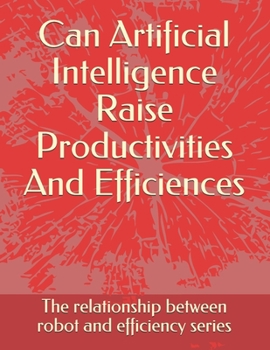
Can Artificial Intelligence Raise Productivities And Efficiences?
No Customer Reviews

⦁Can (AI) technology replace human labour nature of work to raise better productivity and efficiency? On technological innovation reason view point, the history development of artificial intelligence studying the intelligence is one of most ancient scientific discipline. The history development of artificial intelligence what aims to achieve human use to sense, learn remember and think, logic probability, decision making and calculation develop from mathematics, instead of replacement human labor functions.Artificial intelligence history development aim is the scientific analysis of skills in connection and practice with the appearance of computers from 1950 year beginning. The artificial intelligence (AI) can deal with the ultimate challenges. How can ( either biological or electronic) mind sense, understand and manipulate a world that is much simple and more complex than itself? And what if would human like to construct something with such capabilities? The general-purpose software of the early period of (AI) were only able to solve simple tasks effectively and failed when which should be used in a wider range or an more difficult tasks. One of the sources of difficulty was that early software had very few or mix knowledge about the problems which handled, and activities successes by simply syntactic manipulation. Moreover, the other difficulty was that many problems that were tried to solve by the (AI) were untreatable. The early (AI) software whether trying step sequences based on the basic facts about the problem that should be solved, experimented with different combinations till which found a solution. From the end the 1960 year, developing the so-called expert systems were emphasized. These systems had ( sue-based) knowledge base about the field which handled. Till to the beginning of the 1970 year, ( Prolog) the logical programming language was born, which was built in the computation realization of a version of the resolution calculus. ( Prolog) is a remarkably prevalent tool in developing expert systems ( on medical, judiciary and other scopes), but natural language parsers were implemented in this language. Then, in 1981 s, the Japanese announced the fifth generation computer system project, a 10 years plan to build an intelligent computer system that use the ( Prolog) language as a machine code. Nowadays, (AI) can be applied any industries, such as car manufacturing industry can use (AI) technological machine-men manufacture car, instead of replacing human labors in factory. Even, in the future, using (AI) machine-men drivers can drive any private cars or public transportation tools, instead of replacing human drivers, e.g. bus, train, tram, ferry etc. Also in the future, machine-men can replace housewives to serve families to do housekeeping clean job, e.g. cleaning toilets, bathrooms, kitchens, even cooking functions at home. So (AI) machine-man can reduce housewives works at home. Moreover, (AI) machine man can take care old people, when who are living at homes or elder care centers.
Format:Paperback
Language:English
ISBN:1794223487
ISBN13:9781794223486
Release Date:January 1
Publisher:Independently Published
Length:92 Pages
Weight:0.70 lbs.
Dimensions:0.2" x 8.5" x 11.0"
Customer Reviews
0 rating
Copyright © 2026 Thriftbooks.com Terms of Use
| Privacy Policy | Do Not
Sell/Share My Personal Information | Cookie Policy | Cookie Preferences | Accessibility Statement
ThriftBooks® and the ThriftBooks® logo are registered trademarks of Thrift Books Global, LLC
ThriftBooks® and the ThriftBooks® logo are registered trademarks of Thrift Books Global, LLC
