


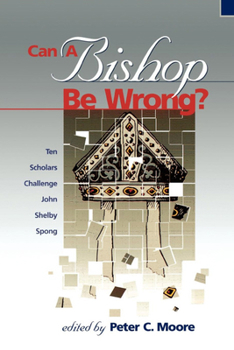
Can A Bishop Be Wrong?


Select Format
Select Condition 
Book Overview
An eminent group of Episcopal scholars and bishops addresses the core issues raised in Bishop Spong's books and teachings on the Virgin birth, resurrection, sexuality, scripture, sin, Jesus, culture, and God. These essays are incisive responses to an articulate and charismatic public figure whose provocative writings have stirred traditional and non-traditional thinkers alike.
While acknowledging that Spong's writing strikes a chord with lay people in the churches and the general public, the book's authors believe a balanced response is needed. They accomplish this by commending the bishop for having the courage of his convictions while challenging his teachings on the cornerstone beliefs of Christian tradition.
Format:Paperback
Language:English
ISBN:0819217263
ISBN13:9780819217264
Release Date:March 1998
Publisher:Morehouse Publishing
Length:176 Pages
Weight:0.68 lbs.
Dimensions:0.6" x 6.3" x 8.9"
Customer Reviews
4 ratings
A long awaited step, but only a step
Published by Thriftbooks.com User , 24 years ago
Peter C. Moore should be applauded for taking the initiative to finally put a book on the market that offers a rebuttal to Spong's New Age 'psuedo Christianity'. However, I have to whole heartedly agree with the other reviewers who comment on the repetition and inconsistent flow. In the beginning the editor does make clear that "Each Chapter stands on it's own, although together they amount to a remarkably unified and weighty challenge to the bishop's thought and an effective rebuttal of his conclusions." (Introduction). While each Chapter as an individual essay on one aspect of Spong's theology do stand alone, the way they are sort of bundled together seem to dampen it's effectiveness and lighten the weight of it's challenge. Despite the editors claims to the contrary, this book seems to try to cater more towards the `scholarly' in it's language and writing style of many of its' scholarly contributors. In fact it rings most vigorously pointing out the flaws in Spong's logic and scholarship which they show most convincingly. However they fail to realize that this flaws of Spong's are self evident to any educated reader who picks up a copy of one of his works. Spong's appeal, and in turn his true danger, is his effect on people who are not as educated in Christian teachings and scholarship. Spong appeals to the 'modern' man and woman who was raised in an age of New Age philosophy. Things like absolute truth and logic are relegated to old stuffy text books hidden in the annals of Academia. Spong's audience wants to know what Christianity can do for them today and now. How can it fit their fixed world view and agenda. A niche that Spong's fills admirably by putting forth distinctively non-Christian thoughts and propaganda decorated nicely under his 'authority' as a Bishop. To that extent only a few Chapters works to answer the true questions that Spong's theology brings to the church without soundly like they `just want to win a debate'. Stephen M. Smith's `Inside the Whirlwind' shows quite effectively that Spong's philosophy is just New Age monism draped in Christian terminology in a fain attempt to be labeled `Christian'. Though relegated to the back of the book, it is actually the first Chapter I would recommend be read. `The Essential Spong' by James M. Stanton does waver from tedious read to engaging and thought provoking writing. One is taken back by the statement `The fundamentalist has no better friend then John Shelby Spong." but Stanton proves his point quite well in his essay. `The Sin of Faith' by Russell R. Reno left me wanting more. He does well in pinpointing the roots of Spong's interpretation of the bible through his work but he seems to go off on one tangent after another and never unifies his points. This `lull' point appears smack in the middle of his chapter and doesn't lighten up till near the end. In conclusion, I feel this book is a stepping stone towards presenting Orthodox Christianity in contrast to Spong's New Age Chris
They Read Spong So You Don't Have To
Published by Thriftbooks.com User , 26 years ago
I confess-- I have something in common with most of the Rt. Rev. Spong's fans. Like them, I've read very little of what he's written. (For example, "Can A Bishop Be Wrong" has two five-star reviews from Spong fans who are under the impression that Spong wrote this book-- apparently, they feel comfortable praising Spong's work sight-unseen).Don't get me wrong. I've tried to read Spong. But, alas, the Rt. Rev. S. is a ghastly writer. After a while, the charms of Spong's writing-- his relentless self-congratulation, his presenting of hackneyed 19th-century pop-biblical-criticism as his own daring innovation, his use of the passive voice to hide sweeping and questionable assertions ("...there is surprise at how insignificant were the theological issues dividing the two sides [of the Reformation]"), his utter lack of a sense of humor, his unforgivably poor skill with words-- begin to pall. I haven't yet met someone who can read an entire chapter of Spong at one sitting.That's where this book comes in handy. They don't exhaustively categorize the intellectual sins of the Rt. Rev. Spong-- such a task could never be worth the trees killed. But they provide a good survey of his looking-glass kingdom. "Can A Bishop Be Wrong" isn't a work of Christian apologetics, because it doesn't have to be. Spong's main contention-- the foundation of all his work-- is his claim that no intelligent person of the twentieth century can be an orthodox Christian. To respond, one doesn't have to prove Christianity-- one just has to provide a counterexample. This book categorizes his errors and logical lapses with admirable thoroughness. Not an exhaustive thoroughness, to be sure, but sufficient to the silly task at hand.This book has its flaws. As others have noted, it is a collection of essays, and they repeat some of the same points over and over. The authors sometimes let Spong goad them into anger. And they don't argue much against Spong's theological outlook-- but since Spong's outlook is just rehashed nineteenth-century "modernism", you can find plenty of orthodox arguments against heavier intellectual forces than Spong. (Try Chesterton's _The_Everlasting_Man_, for starters.)This book has a limited market. Spong's fans will not be moved by what they read here, if they were inclined to try reading it. But to the traditional theist of whatever religion, who wonders whether he ought to read Spong and find out what all the fuss is about, this book offers a strong and well-reasoned answer: "Nope."
modern thought not based on pious myths
Published by Thriftbooks.com User , 26 years ago
He should correspond with Dr Barbara Thiering on the real truths written into the New Testament. When he fully understands it he can write a definitive books to give Christianity a valid basis.
He speaks to those who can no longer accept 4th C theology
Published by Thriftbooks.com User , 26 years ago
If people are safe and comfortable with a faith based upon supernatural theism, the Bishop has nothing to say to them and has no desire to alter or weaken their faith. But for the millions who can no longer accept the theology of a 4th century cosmology and its subsequent human accretions, he gives new understanding of the Christ story. He has provided a profound spirituality that allows us to return to the true Christ, one who was not crucified to compensate for the mythalogical sin of Adam & Eve,but executed for speaking against those powers that oppress; the same powers that oppress today, economic and political elites and theologies that use guilt and fear to control. Bishop Spong understands that stoning has always been the fate of tthe Prophets and I admire his faith and courage to withstand the slings and arrows of little minds.
Copyright © 2026 Thriftbooks.com Terms of Use
| Privacy Policy | Do Not
Sell/Share My Personal Information | Cookie Policy | Cookie Preferences | Accessibility Statement
ThriftBooks® and the ThriftBooks® logo are registered trademarks of Thrift Books Global, LLC
ThriftBooks® and the ThriftBooks® logo are registered trademarks of Thrift Books Global, LLC
