


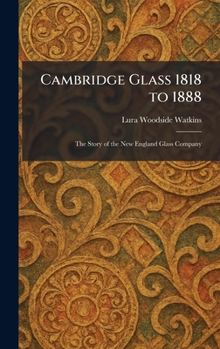
Cambridge Glass 1818 to 1888: The Story of the New England Glass Company

Select Format
Select Condition 
Book Overview
"Cambridge Glass 1818 to 1888: The Story of the New England Glass Company" provides a comprehensive and authoritative history of one of the most significant glass manufacturers in American history. Established in East Cambridge, Massachusetts, the New England Glass Company stood at the forefront of industrial innovation and artistic craftsmanship for seventy years. Lura Woodside Watkins offers a meticulous account of the company's trajectory, tracing its development from its founding in the early nineteenth century through its peak years as a leader in the American glass industry.
The work explores the vast range of glassware produced by the factory, including flint glass, pressed glass, and beautifully engraved pieces that set the standard for quality in the United States. Watkins details the evolution of production techniques, the secret recipes for vibrant colors, and the specific patterns that have since become highly sought after by collectors. Beyond the technical achievements, the book highlights the skilled artisans and laborers whose dedication fueled the company's reputation for excellence.
A vital resource for antique enthusiasts, historians of American industry, and students of decorative arts, this study preserves the legacy of a vital institution. It serves as an essential guide to understanding the intersection of art and industry during a transformative period in American craft history.
This work has been selected by scholars as being culturally important, and is part of the knowledge base of civilization as we know it. This work was reproduced from the original artifact, and remains as true to the original work as possible. Therefore, you may see the original copyright references, library stamps (as most of these works have been housed in our most important libraries around the world), and other notations in the work.
This work is in the public domain in the United States of America, and possibly other nations. Within the United States, you may freely copy and distribute this work, as no entity (individual or corporate) has a copyright on the body of the work.
As a reproduction of a historical artifact, this work may contain missing or blurred pages, poor pictures, errant marks, etc. Scholars believe, and we concur, that this work is important enough to be preserved, reproduced, and made generally available to the public. We appreciate your support of the preservation process, and thank you for being an important part of keeping this knowledge alive and relevant.
Customer Reviews
ThriftBooks® and the ThriftBooks® logo are registered trademarks of Thrift Books Global, LLC
