


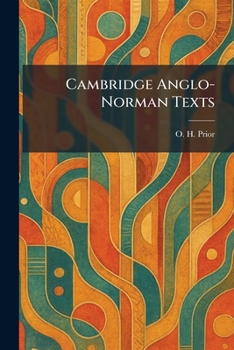
Cambridge Anglo-Norman Texts

"Cambridge Anglo-Norman Texts" is a vital scholarly collection that brings together significant linguistic and literary fragments from the medieval period. Edited by O. H. Prior, this volume serves as a curated gateway into the Anglo-Norman dialect-the variant of Old French that flourished in England following the Norman Conquest. Through a series of meticulously edited texts, the work illustrates the cultural and administrative evolution of Britain during a time of profound transition.
The collection provides readers and researchers with primary source material that highlights the unique synthesis of French and English traditions. These texts encompass various genres, offering insights into the legal, religious, and poetic life of the era. Prior's expert curation emphasizes the philological importance of these writings, making them accessible to students of historical linguistics and medieval studies alike. By preserving these voices, the work underscores the enduring impact of the Anglo-Norman language on the development of modern English literature and law.
As a foundational resource for medievalists, "Cambridge Anglo-Norman Texts" remains an essential reference for understanding the complex linguistic landscape of post-1066 England. It stands as a testament to the intellectual rigor of early 20th-century philology and continues to offer invaluable context for the study of Western European literary history.
This work has been selected by scholars as being culturally important, and is part of the knowledge base of civilization as we know it. This work was reproduced from the original artifact, and remains as true to the original work as possible. Therefore, you may see the original copyright references, library stamps (as most of these works have been housed in our most important libraries around the world), and other notations in the work.
This work is in the public domain in the United States of America, and possibly other nations. Within the United States, you may freely copy and distribute this work, as no entity (individual or corporate) has a copyright on the body of the work.
As a reproduction of a historical artifact, this work may contain missing or blurred pages, poor pictures, errant marks, etc. Scholars believe, and we concur, that this work is important enough to be preserved, reproduced, and made generally available to the public. We appreciate your support of the preservation process, and thank you for being an important part of keeping this knowledge alive and relevant.
Customer Reviews
ThriftBooks ® and the ThriftBooks ® logo are registered trademarks of Thrift Books Global, LLC
