


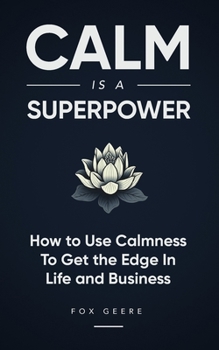
Calm is a Superpower: How to use calmness to get the edge in life and business.
No Customer Reviews

Between these pages, you will learn how to harness the power of calm through examples, tools, actionable recommendations and through a selection of stories where calm was a superpower during recent historical events.
You will gain the knowledge needed to improve your emotional intelligence and you will discover ways to incorporate calm into conflict resolution, decision-making, and daily activities to operate from a position of being loved and respected rather than feared. Being calm truly is a superpower and when you learn to harness it, your life, your work and the way you navigate the world can truly transform. It's like having a cheat code. "It is better to be feared than loved" - These are the famous words of Niccol Machiavelli from over five hundred years ago referencing leadership. Even today, from Nobel Prize winner Daniel Kahneman, respected FBI negotiator Chris Voss, and the always fascinating world of neuroscience, the argument is that our behavior is more motivated by fear and loss than anything else. For this reason, everything from how companies and governments operate to how we purchase and consume products and services is premised on the fear of missing out (FOMO) or losing something. Chris Voss speaks freely about if you find out what the person you are negotiating with is afraid to lose, then you have the upper hand. But how does this information translate to everyday people, leaders and teams? Most of us are not FBI negotiators. One word- Conflict In the real world, we deal with conflict. We must navigate change, differing opinions, cultural perspectives, and generational differences. When we understand people are motivated by loss or fear, we have a choice about if we will leverage that for good or not. We could take advantage and make decisions that instill fear or a sense of loss to get people to do what we want. Of course, you will get those who comply because of the threat. Maybe it is a threat of losing the job or being demoted. Many cannot afford to take the chance-perhaps you might end up calling their bluff. They can't be certain. You will also put others on the defensive, and they become angry or resentful. Things can escalate quickly. Even those that comply will have a shift in attitude. If you think fear-based leadership is the trick to running a profitable company, think again. The Wharton School of Business did a study in 2014, revealing that the "100 Best Companies to Work For" were also the most profitable, measured by higher stock returns. Employee satisfaction is directly linked to your profitability. Does this mean you cannot seek out what employees' fear losing? Of course not. On the contrary, if we take the 'using it for good' approach, you should ideally seek to know what employees fear and what their vision of loss looks like. It is absolutely possible to deploy a positive threat-based leadership style, where we use the information for good. Offering paths and support to resolve the fears and ultimately resolve the conflict. So what is the solution?Calmness.
Being calm matters.
It truly, truly matters.
It also levels you up.
It transforms you.
Format:Paperback
Language:English
ISBN:B0CHL7W1R6
ISBN13:9798851524196
Release Date:September 2023
Publisher:Independently Published
Length:160 Pages
Weight:0.36 lbs.
Dimensions:0.3" x 5.0" x 8.0"
Customer Reviews
0 rating
Copyright © 2026 Thriftbooks.com Terms of Use
| Privacy Policy | Do Not
Sell/Share My Personal Information | Cookie Policy | Cookie Preferences | Accessibility Statement
ThriftBooks® and the ThriftBooks® logo are registered trademarks of Thrift Books Global, LLC
ThriftBooks® and the ThriftBooks® logo are registered trademarks of Thrift Books Global, LLC
