


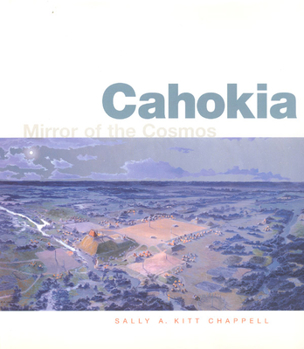
Cahokia: Mirror of the Cosmos


Select Format
Select Condition 
Book Overview
At the turn of the last millennium, a powerful Native American civilization emerged and flourished in the American Midwest. By A.D. 1050 the population of its capital city, Cahokia, was larger than that of London. Without the use of the wheel, beasts of burden, or metallurgy, its technology was of the Stone Age, yet its culture fostered widespread commerce, refined artistic expression, and monumental architecture. The model for this urbane world was nothing less than the cosmos itself. The climax of their ritual center was a four-tiered pyramid covering fourteen acre rising a hundred feet into the sky--the tallest structure in the United States until 1867. This beautifully illustrated book traces the history of this six-square-mile area in the central Mississippi Valley from the Big Bang to the present. Chappell seeks to answer fundamental questions about this unique, yet still relatively unknown space, which was designated a UNESCO World Heritage Site in 1982. How did this swampy land become so amenable to human life? Who were the remarkable people who lived here before the Europeans came? Why did the whole civilization disappear so rapidly? What became of the land in the centuries after the Mississippians abandoned it? And finally, what can we learn about ourselves as we look into the changing meaning of Cahokia through the ages? To explore these questions, Chappell probes a wide range of sources, including the work of astronomers, geographers, geologists, anthropologists, and archaeologists. Archival photographs and newspaper accounts, as well as interviews with those who work at the site and Native Americans on their annual pilgrimage to the site, bring the story up to the present. Tying together these many threads, Chappell weaves a rich tale of how different people conferred their values on the same piece of land and how the transformed landscape, in turn, inspired different values in them-cultural, spiritual, agricultural, economic, and humanistic.
Format:Hardcover
Language:English
ISBN:0226101363
ISBN13:9780226101361
Release Date:February 2002
Publisher:University of Chicago Press
Length:238 Pages
Weight:2.07 lbs.
Dimensions:0.8" x 8.7" x 9.9"
Customer Reviews
2 ratings
How to preserve a great American city...
Published by Thriftbooks.com User , 19 years ago
North America has at least one ancient pyramid. A dirt one. Situated within a very fertile region known as the American Bottom, the extent of its base overshadows even the Great Pyramid at Giza. And though some today might dismiss it as a weathered lump of soil - the elements have taken their toll - it once towered over North America's greatest medieval city. Known as "Monk's Mound," because a group of early 19th century monks set up shop there, the structure rises some 100 feet over the southwestern Illinois wetlands. Photographs can't capture its ominous girth. Nor can they convey the anti-gravitational energy required to ascend to the summit from which the St. Louis Arch is visible. The panoramic view from on top, a modern rural landscape punctuated with human-made dollops, belies a metropolis that once rivaled London and Rome in population. Between 900 and 1550, an estimated 100,000 - 150,000 people lived in this city now known as "Cahokia." But sometime in the mid-16th century, just before pointy French hats infiltrated Illinois, it was abandoned. Mystery shrouds Cahokia and its people. They left no known written or verbal records. To add to the mystique, no North American city equalled Cahokia in size until Philadelphia overtook it in the early 19th century. As a shadowy symbol of its former strength, North America's Great Pyramid still stands, miraculously, where it was built over a thousand years ago. "Cahokia: Mirror of the Cosmos" provides a historical survey of the land and the mystery surrounding Monk's Mound from the Big Bang to approximately 2002. Why the author reached back to the nanosecond of creation remains a little obscure, but that tiny section leads to an interesting discussion of the topographical and geological formation of the American bottom. Thanks to many natural forces the ancient Cahokians, or "Mississippians," found rich fertile soil in the center of North America. They settled there sometime before 900 and fed their burgeoning populace from gifts deposited by glaciers millennia before. What happened at Cahokia afterwards remains, as said above, subject to speculation. Regardless, an entire chapter explores what might have happened based on the meager evidence archeologists have uncovered. Evidence exists for a stratfied society with social classes, an elite, and a worker class. Pottery and artifacts found at the site demonstrate sophisticated artistic skill. They played a game called "chunkey." Some evidence exists that Cahokians used mathematics to design their city, set up an astrological calendar, named "woodhenge," and fortify the inner city with a bastion-lined stockade. The book also explores theories for why Cahokia was abandoned. Everything from climate change, resource depletion, wars, and nutritional or sanitational problems receives at least a cursory analysis. In addition, the book cites the uncommon theory that the Cahokians simply "moved on." Maybe no tragedy occurred? Maybe they willingly abandoned
ancient american city
Published by Thriftbooks.com User , 24 years ago
This is a stunning book, in every way: lavishly illustrated and a gorgeous, full-color design. Sally Chappell, who writes for the Travel Section of the New York Times, tells a fascinationg story of a sophisticated ancient culture and empire that thrived along the Mississippi valley between 1100 and 1500, at the same time that the Aztecs were coming into power in Meso-America and the Incas in South America. Cahokia was the major city of this empire, and in 1200 its population exceeded that of London in Europe. Chappell tells the story of this historic site near St. Louis, with its fabulous monumental architecture, relgious traditions, and trading networks. But Chappell takes it well beyond the story of the Native Americans. She explores how the site evolved over time, was influenced by French explorers, was used during the Civil War, and what became of the site in the 20th century. An amazing story of both a place and "place."
Copyright © 2026 Thriftbooks.com
Terms of Use | Privacy Policy | Do Not Sell/Share My Personal Information | Cookie Policy | Cookie Preferences | Accessibility Statement
ThriftBooks ® and the ThriftBooks ® logo are registered trademarks of Thrift Books Global, LLC
ThriftBooks ® and the ThriftBooks ® logo are registered trademarks of Thrift Books Global, LLC
