


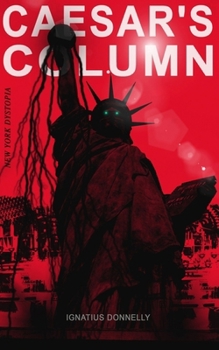
Caesar's Column (New York Dystopia): A Fascist Nightmare of the Rotten 20th Century American Society - Time Travel Novel from the Renowned Author of A


Select Format
Select Condition 
Book Overview
In Ignatius Donnelly's provocative novel, "Caesar's Column," the author constructs a vivid dystopian narrative set in a grim future America where capitalism has spiraled into tyranny, illustrating the dangers of unchecked industrial power. Written in the late 19th century during a period of social upheaval and economic disparity, Donnelly employs a blend of speculative fiction and sociopolitical critique to explore themes of class struggle, government corruption, and revolutionary activism. His eloquent prose embraces elements of realism and allegory, reflecting anxieties about societal decay and the urgent calls for reform that characterized his time. Donnelly, a fervent advocate for social justice and a prominent figure in the Populist movement, draws on his rich background as a politician, writer, and student of history to inform his narrative. His experiences in the political arena, combined with deep-seated concerns about the future of democracy, undoubtedly influenced the dystopian vision presented in this novel. Through his work, Donnelly sought to awaken the public consciousness to the pressing issues of rampant inequality and the loss of individual rights. "Caesar's Column" serves as both a cautionary tale and a clarion call for change, making it an essential read for those interested in the intersections of literature, politics, and societal evolution. As readers navigate this harrowing world, they will find themselves challenged to contemplate their roles in shaping future societies, making this novel not only timely but also profoundly relevant to contemporary discussions on political ethics and moral responsibility.
Format:Paperback
Language:English
ISBN:8027330041
ISBN13:9788027330041
Release Date:December 2018
Publisher:E-Artnow
Length:164 Pages
Weight:0.72 lbs.
Dimensions:0.3" x 6.0" x 9.0"
Customer Reviews
1 rating
Wonderful Edition
Published by Thriftbooks.com User , 17 years ago
"Cæsar's Column: A Story of the Twentieth Century" by Ignatius Donnelly is the 10th book in the Early Classics of Science Fiction series. "Cæsar's Column" was first published in 1890 and though it is far from a great work, it holds a special place in the history of speculative fiction. The novel deals with a dystopian/utopian future (1988) and draws heavily on the author's own political views. Ignatius Donnelly was a populist politician moving from party to party and switching positions on issues frequently, eventually joining the Republican party and being elected as Lieutenant Governor of Minnesota and then to Congress. Donnelly also became known for his writing, as he wrote about such diverse topics as Atlantis, Ragnarok, and the true authorship of Shakespeare's works. Those were all considered non-fiction works though, and after being discredited he wrote "Cæsar's Column", a fictional work, under the pseudonym of Edmund Boisgilbert, M.D., though this was more of a publicity stunt than a real attempt to conceal his identity. "Cæsar's Column" is an important work in the history of speculative fiction because it is one of the earliest works which brings the ideas of Jules Verne to an American audience, though certainly not with the same level of quality. This work also looks at social Darwinism, and Donnelly's impression of where it will lead the society in the next 100 years. As is a general rule with this series, the quality comes not just with the works being presented, as many of them are far from ideal; but rather it is the supporting documentation which makes them well worth reading. In this case, it is the superb introduction and notes provided by Nicholas Ruddick which make this the ideal edition of this work to read. "Cæsar's Column: A Story of the Twentieth Century" takes place in the year 1988, mostly in New York City in a society which has decayed and lost its ideals. The narrator for much of the story is Gabriel Welstein, a visitor from the Swiss colony of Uganda, an agricultural utopian society. He has come to the U.S. to bypass the global Wool Ring which has monopolized the commodity, and most of the book is in the form of letters which Gabriel is writing to his brother Heinrich. In the city, Gabriel intervenes to save a beggar, who turns out to be Maximilian Petion, an attorney who is part of a brotherhood (the Brotherhood of Destruction) that is working to overthrow the corrupt ruling class. Much of the story deals with Donnelly's views on society and politics and in particular on the concept of social Darwinism. He provides a view of future technology which isn't too far off the mark with airships, city streets alight, though with power obtained from the Aurora Borealis instead of electrical power plants. One could say that the televised newspapers are a foreshadowing of the internet as well. There is some examples of anti-Semitism in the work as well, though as Ruddock discusses in his introduction it is pro
Copyright © 2026 Thriftbooks.com
Terms of Use | Privacy Policy | Do Not Sell/Share My Personal Information | Cookie Notice | Cookie Preferences | Accessibility Statement
ThriftBooks ® and the ThriftBooks ® logo are registered trademarks of Thrift Books Global, LLC
ThriftBooks ® and the ThriftBooks ® logo are registered trademarks of Thrift Books Global, LLC
