


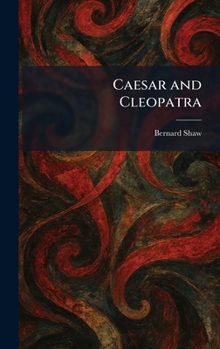
Caesar and Cleopatra

"Caesar and Cleopatra" is a brilliant historical drama by the Nobel Prize-winning playwright Bernard Shaw. Departing from the romanticized versions of history popularized by William Shakespeare, Shaw presents a more cerebral and witty exploration of the encounter between the legendary Roman general Julius Caesar and the young, impressionable Cleopatra, Queen of Egypt.
Set against the backdrop of the Roman occupation of Egypt, the play portrays Caesar not as a tragic lover, but as a pragmatic, weary, and profoundly wise statesman. He takes the teenage Cleopatra under his wing, attempting to mold her into a formidable and strategic ruler. As they navigate the treacherous waters of court intrigue and the complex politics of the Mediterranean, the work delves into themes of power, morality, and the cyclical nature of history. Through sharp dialogue and Shaw's signature social commentary, the play examines the true cost of leadership and the often-cynical realities of empire-building.
A cornerstone of modern drama, "Caesar and Cleopatra" remains an essential read for those interested in historical fiction, political philosophy, and the masterful character development for which Shaw is renowned. This work continues to captivate audiences with its intellectual depth and timeless observations on human nature and governance.
This work has been selected by scholars as being culturally important, and is part of the knowledge base of civilization as we know it. This work was reproduced from the original artifact, and remains as true to the original work as possible. Therefore, you may see the original copyright references, library stamps (as most of these works have been housed in our most important libraries around the world), and other notations in the work.
This work is in the public domain in the United States of America, and possibly other nations. Within the United States, you may freely copy and distribute this work, as no entity (individual or corporate) has a copyright on the body of the work.
As a reproduction of a historical artifact, this work may contain missing or blurred pages, poor pictures, errant marks, etc. Scholars believe, and we concur, that this work is important enough to be preserved, reproduced, and made generally available to the public. We appreciate your support of the preservation process, and thank you for being an important part of keeping this knowledge alive and relevant.
Related Subjects
DramaCustomer Reviews
ThriftBooks ® and the ThriftBooks ® logo are registered trademarks of Thrift Books Global, LLC
