


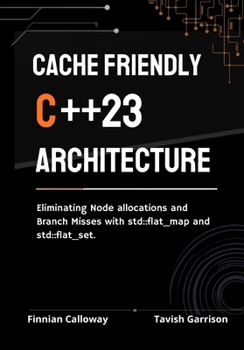
Cache Friendly C++23 Architecture: Eliminating Node Allocations and Branch Misses with std::flat_map and std::flat_set (The C++ Field Guide Series)
No Customer Reviews

Your std:: map lookups are slow, and it is not your algorithm's fault. It is where the CPU has to go to find the data.
Node based containers scatter every element across the heap, one allocation per insert, no two nodes guaranteed to sit anywhere near each other. Your CPU doesn't fetch one value at a time, it pulls a 64 byte cache line on the assumption that whatever you touch next is close to what you just touched, and a red black tree defeats that assumption at every level of descent. A cache miss costs 100 to 300 cycles. A hit costs 4 or 5. std:: flat_map and std:: flat_set fix this by trading tree nodes for sorted vectors, and the difference shows up in cache misses avoided and branches predicted correctly, not just in a benchmark that says "faster."
Cache Friendly C++23 Architecture is not an introduction to flat_map's API surface. It is a strictly technical, mechanism first guide for engineers who already ship C++23 and need to know exactly when a flat container earns its keep, when it doesn't, and what silently breaks during migration if you treat it as a drop in replacement for std:: map.
Through precise mechanism level reasoning, production grade code, and real failure cases pulled from actual migrations, you will learn to reason about container choice the way the underlying hardware actually behaves, not the way Big O notation tells you it should.
Inside the Book, You Will Diagnose and Fix:
The Cache Miss Problem: Understand exactly why pointer chasing defeats the CPU's prefetcher, in cycles, not vague gestures at "modern hardware," and why a rebalancing tree costs more under load than its amortized complexity admits.
Choosing Flat When You Shouldn't: Recognize the specific churn patterns, adversarial key order, sustained high volume insertion, where a flat container's linear insertion cost compounds instead of amortizing, and a tree wins outright.
Silent Correctness Bugs During Migration: Catch the non-const key that breaks generic code with no compiler warning, the comparator assumption that held for years against a tree and fails the moment a sort touches it, and the constructor that trusts a precondition nobody verified.
Getting the Performance You Actually Came For: Reserve capacity correctly, exploit sorted range construction, and stop paying for a reallocation cost you had every ability to avoid.
Custom Containers and Allocator Control: Know precisely when swapping the underlying storage or writing a custom allocator is worth the complexity, and when it's solving a problem you haven't confirmed you have.
Where Flat Containers Stop: Recognize the point where a sorted array can't solve your actual problem, multi-dimensional query, priority extraction under heavy churn, graph traversal, no matter how well you tune it, and know which structure to reach for instead.
Stop reaching for flat_map because a benchmark said so. Whether you're migrating an existing codebase or designing a new one, this book gives you the exact mechanism, code, and decision rules to know when a sorted vector wearing an associative container's interface is the right call, and when it isn't.
Who this book is for: senior C++ engineers and systems programmers who already work with C++23 and need to move past "flat_map is faster" into knowing precisely why, and precisely when it stops being true. It assumes working knowledge of C++ and standard container usage. It is not an introduction to data structures for beginners.
Scroll up and click "Buy Now" to stop guessing at your next container choice.
Node based containers scatter every element across the heap, one allocation per insert, no two nodes guaranteed to sit anywhere near each other. Your CPU doesn't fetch one value at a time, it pulls a 64 byte cache line on the assumption that whatever you touch next is close to what you just touched, and a red black tree defeats that assumption at every level of descent. A cache miss costs 100 to 300 cycles. A hit costs 4 or 5. std:: flat_map and std:: flat_set fix this by trading tree nodes for sorted vectors, and the difference shows up in cache misses avoided and branches predicted correctly, not just in a benchmark that says "faster."
Cache Friendly C++23 Architecture is not an introduction to flat_map's API surface. It is a strictly technical, mechanism first guide for engineers who already ship C++23 and need to know exactly when a flat container earns its keep, when it doesn't, and what silently breaks during migration if you treat it as a drop in replacement for std:: map.
Through precise mechanism level reasoning, production grade code, and real failure cases pulled from actual migrations, you will learn to reason about container choice the way the underlying hardware actually behaves, not the way Big O notation tells you it should.
Inside the Book, You Will Diagnose and Fix:
The Cache Miss Problem: Understand exactly why pointer chasing defeats the CPU's prefetcher, in cycles, not vague gestures at "modern hardware," and why a rebalancing tree costs more under load than its amortized complexity admits.
Choosing Flat When You Shouldn't: Recognize the specific churn patterns, adversarial key order, sustained high volume insertion, where a flat container's linear insertion cost compounds instead of amortizing, and a tree wins outright.
Silent Correctness Bugs During Migration: Catch the non-const key that breaks generic code with no compiler warning, the comparator assumption that held for years against a tree and fails the moment a sort touches it, and the constructor that trusts a precondition nobody verified.
Getting the Performance You Actually Came For: Reserve capacity correctly, exploit sorted range construction, and stop paying for a reallocation cost you had every ability to avoid.
Custom Containers and Allocator Control: Know precisely when swapping the underlying storage or writing a custom allocator is worth the complexity, and when it's solving a problem you haven't confirmed you have.
Where Flat Containers Stop: Recognize the point where a sorted array can't solve your actual problem, multi-dimensional query, priority extraction under heavy churn, graph traversal, no matter how well you tune it, and know which structure to reach for instead.
Stop reaching for flat_map because a benchmark said so. Whether you're migrating an existing codebase or designing a new one, this book gives you the exact mechanism, code, and decision rules to know when a sorted vector wearing an associative container's interface is the right call, and when it isn't.
Who this book is for: senior C++ engineers and systems programmers who already work with C++23 and need to move past "flat_map is faster" into knowing precisely why, and precisely when it stops being true. It assumes working knowledge of C++ and standard container usage. It is not an introduction to data structures for beginners.
Scroll up and click "Buy Now" to stop guessing at your next container choice.
Format:Paperback
Language:English
ISBN:B0HG8MQY7G
ISBN13:9798194519422
Release Date:August 2026
Publisher:Independently published
Length:121 Pages
Weight:0.46 lbs.
Dimensions:9.6" x 0.3" x 6.7"
Customer Reviews
0 rating
Copyright © 2026 Thriftbooks.com
Terms of Use | Privacy Policy | Do Not Sell/Share My Personal Information | Cookie Policy | Cookie Preferences | Accessibility Statement
ThriftBooks ® and the ThriftBooks ® logo are registered trademarks of Thrift Books Global, LLC
ThriftBooks ® and the ThriftBooks ® logo are registered trademarks of Thrift Books Global, LLC
