


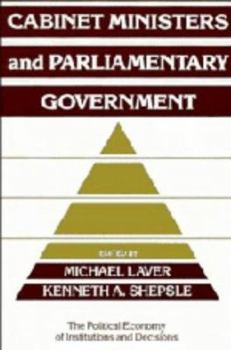
Cabinet Ministers and Parliamentary Government
No Customer Reviews

One of the key constitutional features of a parliamentary democracy is that the political executive, or cabinet, derives its mandate from - and is politically responsible to - the legislature. What makes a parliamentary democracy democratic is that, once a legislative election has been held, the new legislature has the power to dismiss the incumbent executive and replace it with a new one. Moreover, it sits essentially as a court, passing continual judgement on the record of the executive, and continuous sentence on its future prospects. That is how citizens, indirectly, choose and control their government. But the relationship between legislature and executive is not one-sided. The executive typically has the authority to recommend dissolution of parliament and is usually drawn from the parliament. Executive personnel, therefore, have intimate familiarity with parliamentary practices; and for their part, parliamentary personnel aspire to executive appointments. Surprisingly little is known about the constitutional relationship between legislature and executive in parliamentary regimes; the present volume seeks to remedy this.
Format:Paperback
Language:English
ISBN:0521438373
ISBN13:9780521438377
Release Date:September 1994
Publisher:Cambridge University Press
Length:332 Pages
Weight:1.00 lbs.
Dimensions:0.6" x 6.0" x 8.9"
Customer Reviews
0 rating
Copyright © 2026 Thriftbooks.com Terms of Use
| Privacy Policy | Do Not
Sell/Share My Personal Information | Cookie Policy | Cookie Preferences | Accessibility Statement
ThriftBooks® and the ThriftBooks® logo are registered trademarks of Thrift Books Global, LLC
ThriftBooks® and the ThriftBooks® logo are registered trademarks of Thrift Books Global, LLC
