


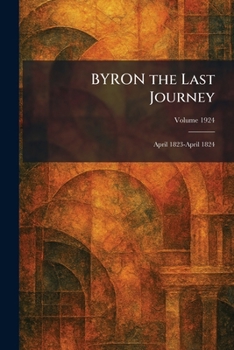
BYRON the Last Journey: April 1823-April 1824

"BYRON the Last Journey April 1823-April 1824-1924" provides a detailed and poignant account of the final year in the life of George Gordon Byron, one of the most influential and celebrated figures of the Romantic era. Focusing on the pivotal period leading up to his death, this historical biography chronicles Byron's departure from Italy and his fateful commitment to the cause of Greek independence. The work meticulously reconstructs the poet's final months, exploring his interactions with revolutionary leaders and his efforts to organize military support in Missolonghi.
Through this narrative, readers gain a profound understanding of Byron's internal struggles and his transition from a world-weary celebrity to a dedicated political activist. The text examines the complexities of the Greek struggle against Ottoman rule and the significant personal sacrifices Byron made to support a nation's quest for liberty. By detailing the day-to-day realities of his final mission, "BYRON the Last Journey April 1823-April 1824-1924" captures the intersection of literary legend and historical reality. It serves as an essential exploration of the poet's enduring legacy and his ultimate transformation into a martyr for freedom, offering a compelling look at the man behind the myth during his most defining year.
This work has been selected by scholars as being culturally important, and is part of the knowledge base of civilization as we know it. This work was reproduced from the original artifact, and remains as true to the original work as possible. Therefore, you may see the original copyright references, library stamps (as most of these works have been housed in our most important libraries around the world), and other notations in the work.
This work is in the public domain in the United States of America, and possibly other nations. Within the United States, you may freely copy and distribute this work, as no entity (individual or corporate) has a copyright on the body of the work.
As a reproduction of a historical artifact, this work may contain missing or blurred pages, poor pictures, errant marks, etc. Scholars believe, and we concur, that this work is important enough to be preserved, reproduced, and made generally available to the public. We appreciate your support of the preservation process, and thank you for being an important part of keeping this knowledge alive and relevant.
Customer Reviews
ThriftBooks ® and the ThriftBooks ® logo are registered trademarks of Thrift Books Global, LLC
