


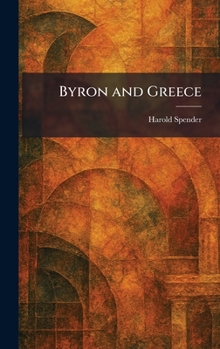
Byron and Greece

Select Format
Select Condition 
Book Overview
"Byron and Greece" provides a comprehensive and moving exploration of the profound bond between the iconic Romantic poet Lord Byron and the nation of Greece. This work delves into Byron's deep-seated passion for the Greek cause, documenting his transition from a traveler enchanted by the ruins of antiquity to a committed leader in the 19th-century struggle for independence.
Through a careful examination of historical events and literary analysis, the book illuminates how Greece served as a primary muse for Byron's most celebrated works while tracing his personal evolution. It captures the spirit of Philhellenism that swept through Europe, fueled by Byron's own celebrity and his ultimate sacrifice at Missolonghi. Readers will find a detailed account of his interactions with Greek leaders, his financial contributions to the revolution, and the enduring legacy he left behind in both the literary and political spheres.
Harold Spender presents a scholarly yet accessible study that underscores the historical importance of Byron's involvement in the Greek War of Independence. By weaving together the poet's personal correspondence and literary output, the work offers a vivid portrait of a man whose life and death became inextricably linked with the birth of a modern nation.
This work has been selected by scholars as being culturally important, and is part of the knowledge base of civilization as we know it. This work was reproduced from the original artifact, and remains as true to the original work as possible. Therefore, you may see the original copyright references, library stamps (as most of these works have been housed in our most important libraries around the world), and other notations in the work.
This work is in the public domain in the United States of America, and possibly other nations. Within the United States, you may freely copy and distribute this work, as no entity (individual or corporate) has a copyright on the body of the work.
As a reproduction of a historical artifact, this work may contain missing or blurred pages, poor pictures, errant marks, etc. Scholars believe, and we concur, that this work is important enough to be preserved, reproduced, and made generally available to the public. We appreciate your support of the preservation process, and thank you for being an important part of keeping this knowledge alive and relevant.
Customer Reviews
ThriftBooks ® and the ThriftBooks ® logo are registered trademarks of Thrift Books Global, LLC
