


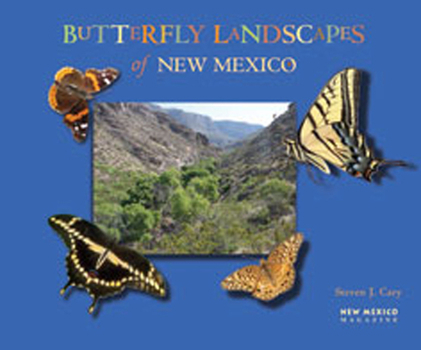
Butterfly Landscapes of New Mexico

Butterfly Landscapes of New Mexico breaks new ground by organizing butterflies around elements of landscape and habitat. This useful book helps butterfly lovers find the more than three hundred kinds of butterflies scattered in our state's diverse landscape. Steven Cary reveals New Mexico butterflies as expressions of local topography, climate, and plants. His vivid photographs and informative text first portray butterflies within a region and then in progressively smaller components of landscape. Cary's perspective is intimate and imaginative. A handy companion in the field or the living room, this book appeals to butterfly enthusiasts and others eager to learn about the state's remarkable array of butterflies.
Format:Paperback
Language:English
ISBN:1934480037
ISBN13:9781934480038
Release Date:November 2009
Publisher:New Mexico Magazine
Length:167 Pages
Weight:1.40 lbs.
Dimensions:0.6" x 7.4" x 9.0"
Customer Reviews
3 ratings
Great Book!
Published by Thriftbooks.com User , 16 years ago
Just the book I needed. As a butterfly photographer this book tells me where and when to look for the species in my area. Very well written and concise. I have learned a lot about my regional butterflies from this book and would recommend to anyone interested in New Mexico butterflies.
A fine addition to any nature or science library collection
Published by Thriftbooks.com User , 16 years ago
The butterfly has inspired wonder and curiosity ever since humanity has laid eyes on it. "Butterfly Landscapes of New Mexico" takes a look at this awe-inspiring creatures of New Mexico, from New Mexico's self-proclaimed (and elsewhere proclaimed) Butterfly Guy. Looking at the habitat of these creatures, author Steven J. Cary brings readers a wealth of intriguing information. "Butterfly Landscapes of New Mexico" is a fine addition to any nature or science library collection.
Tiny bits of beauty in a beautiful state
Published by Thriftbooks.com User , 16 years ago
Steven J. Cary has written and illustrated a wonderful guide to New Mexico butterflies, not only to the butterflies, but also to the specific landscapes that support them. The book lies flat when opened and is small enough to carry in a day pack, especially if you are traveling light with only a trail guide book, a pair of binoculars and, of course, water. New Mexico has over 300 species of butterflies, among the highest number of all states because of its diverse habitats, from Lower Sonoran through Hudsonian, a wide topographic range from 3000 to over 13,000 feet elevation, and because it lies at the junction of the Great Plains, Rocky Mountains, Colorado Plateau and Chihuahuan Desert. A direct overland connection to Mexico and the American subtropics yields an influx of subtropical strays. For example, naturalists have identified 103 species of butterflies and skippers in the Los Alamos area, and over 150 species in the Jemez Mountains. Among the New Mexico butterflies is the small, spectacular Sandia Hairstreak, the official State Butterfly. It can be seen flying around stands of its hostplant, Texas beargrass, at several state parks in eastern and southern New Mexico in March and April. Cary provides some general advice on seeking out butterflies on the New Mexico State Parks website: "The secret to successful butterflying is being in the right places at the right times. The right times often coincide with warm temperatures and greatest moisture availability. For southern New Mexico and areas below 5000 feet elevation, this means spring (March - May) and late summer into autumn (July - October). For northern New Mexico and areas above 8000 feet elevation, this means late spring and summer (May - August). Also check recent weather information; butterflies in desert areas are very sensitive to soil moisture; the greatest abundance of butterfly adults usually occurs 3 to 4 weeks after heavy rains. Of course, each species has its own life cycle in which adults fly when they need to. A little bit of homework - studying up on the particular critters that interest you - can pay dividends and avert disappointment. For best results, check your field guides and other reference materials before scheduling your visit." The website also lists some species that you can find at some of the State Parks; Cary's book is much more detailed, of course: Cimarron Canyon -- Mormon Metalmark and Strecker's Yucca-skipper City of Rocks -- Rita Blue and Desert Checkered-skipper Clayton Lake -- Gray Copper and Bronze Copper Percha Dam -- Desert Viceroy and subtropical vagrants Manzano Mountains -- Colorado Hairstreak and Spalding's Dotted-blue Oliver Lee Memorial -- Sandia Hairstreak and Viereck's Skipper Rio Grande Nature Center -- Mariposaville Pollinator Garden Rock Hound -- Desert Orangetip and Streaky Skipper Sugarite Canyon -- Alberta Arctic and Mexican Sootywing Sumner Lake -- Sandia Hairstreak and subtropical vagrants A goo
Copyright © 2026 Thriftbooks.com
Terms of Use | Privacy Policy | Do Not Sell/Share My Personal Information | Cookie Policy | Cookie Preferences | Accessibility Statement
ThriftBooks ® and the ThriftBooks ® logo are registered trademarks of Thrift Books Global, LLC
ThriftBooks ® and the ThriftBooks ® logo are registered trademarks of Thrift Books Global, LLC
