


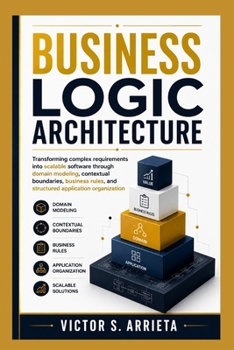
Business Logic Architecture: Transforming complex requirements into scalable software through domain modeling, contextual boundaries, business rules,
No Customer Reviews

BUSINESS LOGIC ARCHITECTURE Complex software begins with complex problems. Turning business requirements into reliable software requires a clear understanding of the domain, well-defined rules, meaningful boundaries, and an organized approach to application design. BUSINESS LOGIC ARCHITECTURE explores the principles and practices involved in transforming complex requirements into structured software through domain modeling, contextual boundaries, business rules, and application organization. The book examines how business concepts can be translated into software structures that remain understandable, maintainable, and adaptable as applications grow and requirements change. Readers will explore: - How to analyze and organize complex business requirements
- Principles of domain modeling and domain-oriented design
- How business rules can be represented within software systems
- Defining boundaries between different areas of an application
- Identifying relationships between business entities and processes
- Organizing application components around business responsibilities
- Managing complexity through clear architectural structures
- Modeling business processes and application workflows
- Designing software that can accommodate evolving requirements
- Improving consistency between business requirements and implementation
- Architectural considerations for maintainable and scalable applications Business logic sits at the point where real-world requirements become executable software. When that logic is poorly organized, applications can become difficult to understand, test, modify, and extend. When it is modeled carefully, the structure of the software can provide a clearer representation of the problem it is intended to solve. BUSINESS LOGIC ARCHITECTURE presents an engineering-oriented approach to organizing this complexity. It considers how domain concepts, rules, boundaries, workflows, and application structures can work together to form a coherent software architecture. For software engineers, developers, architects, technical leads, and students of software design, this book provides a structured framework for understanding how business requirements can influence software architecture and how well-organized business logic can support applications as they evolve. The emphasis is on systematic thinking, clear modeling, and disciplined architectural organization, providing readers with a foundation for reasoning about the relationship between business problems and software systems.
Format:Paperback
Language:English
ISBN:B0HHDZHJK7
ISBN13:9798170708512
Release Date:August 2026
Publisher:Independently Published
Length:256 Pages
Weight:0.76 lbs.
Dimensions:0.5" x 6.0" x 9.0"
Customer Reviews
0 rating
Copyright © 2026 Thriftbooks.com
Terms of Use | Privacy Policy | Do Not Sell/Share My Personal Information | Cookie Notice | Cookie Preferences | Accessibility Statement
ThriftBooks ® and the ThriftBooks ® logo are registered trademarks of Thrift Books Global, LLC
ThriftBooks ® and the ThriftBooks ® logo are registered trademarks of Thrift Books Global, LLC
