


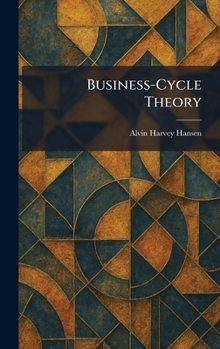
Business-Cycle Theory

"Business-Cycle Theory" offers a profound examination of the recurring fluctuations that define modern industrial economies. Written by Alvin Harvey Hansen, one of the most influential American economists of the twentieth century, this work provides a systematic analysis of the causes behind economic expansions and contractions. Hansen explores the complex interplay between capital investment, technological innovation, and monetary factors, synthesizing diverse economic perspectives into a cohesive study of market instability.
The book serves as a vital bridge between classical economic thought and modern macroeconomics. Hansen meticulously evaluates contemporary theories of the period, offering insights into the structural dynamics of capitalism and the factors that drive investment cycles. By investigating the relationship between the production of capital goods and consumer demand, "Business-Cycle Theory" lays the groundwork for understanding the volatility of the global economy. This text remains an essential resource for students of economic history and scholars interested in the evolution of macroeconomic policy and theory.
This work has been selected by scholars as being culturally important, and is part of the knowledge base of civilization as we know it. This work was reproduced from the original artifact, and remains as true to the original work as possible. Therefore, you may see the original copyright references, library stamps (as most of these works have been housed in our most important libraries around the world), and other notations in the work.
This work is in the public domain in the United States of America, and possibly other nations. Within the United States, you may freely copy and distribute this work, as no entity (individual or corporate) has a copyright on the body of the work.
As a reproduction of a historical artifact, this work may contain missing or blurred pages, poor pictures, errant marks, etc. Scholars believe, and we concur, that this work is important enough to be preserved, reproduced, and made generally available to the public. We appreciate your support of the preservation process, and thank you for being an important part of keeping this knowledge alive and relevant.
Customer Reviews
ThriftBooks ® and the ThriftBooks ® logo are registered trademarks of Thrift Books Global, LLC
