


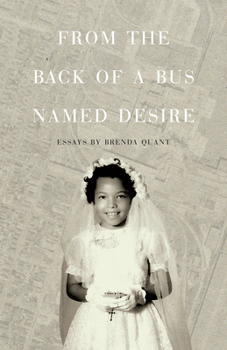
From the Back of a Bus Named Desire

At the tender age of ten, Brenda Quant became "the happiest criminal in New Orleans" by swinging on the swingset at a whites-only park under her mother's watchful eye. This was the beginning of a lifelong orientation toward not only social justice, but deep and critical observation of the world around her.
Growing up in the 9th Ward of New Orleans in the 1950s, Brenda Quant witnessed the last gasps of Jim Crow as well as everyday acts of resistance undertaken by relatives and community members. This book reflects a lifetime of experience, and its essays take many forms: a truth-seeking conversation with her ancestor who may or may not have fought as a Black Confederate soldier; a cultural history excavating the tangled roots of rice; and a m lange of fragmented, candid meditations on works of visual art.
Quant earned her MFA from the University of New Orleans at the age of seventy. She died in 2022, leaving the world with this book, which served as her thesis. These essays are contemplations on the power of pathways, whether diasporic seaways or neighborhood sidewalks. With humor, candor, and a diligent curiosity about the world, Brenda Quant's vision of New Orleans is among the most true of a city whose image precedes it.
Customer Reviews
ThriftBooks ® and the ThriftBooks ® logo are registered trademarks of Thrift Books Global, LLC
