


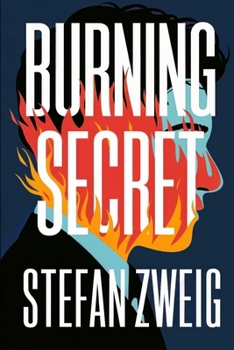
Burning Secret: A New Translation

He thought he had found a friend. He was only a means to an end.
Twelve-year-old Edgar has never known such attention. At a fashionable Austrian spa resort, a sophisticated Baron befriends him with elaborate charm, treating the boy as an equal, promising adventures, filling the void left by Edgar's distant, preoccupied father. For the first time, Edgar feels seen, valued, important.
But the Baron's interest in Edgar is purely instrumental. His real target is Edgar's mother-beautiful, refined, apparently susceptible to flattery from a titled stranger. The boy is merely the key, the excuse for proximity, the cover for increasingly intimate encounters between the Baron and a married woman whose husband remains conveniently in Vienna.
As Edgar watches his friend and his mother together-their coded conversations, their elaborate charade of accidental meetings-he begins to sense something he cannot name, to perceive a dimension of adult interaction that both excludes and disturbs him. Jealousy transforms into confusion, confusion into a dawning, terrible understanding: he has been used, manipulated, discarded. The friendship he treasured never existed. The Baron never cared about him at all.
Stefan Zweig's psychologically devastating novella is a masterpiece of compressed intensity-the portrait of innocence confronting betrayal, of a child forced into premature knowledge that scars rather than enlightens. Set in the refined, suffocating atmosphere of pre-World War I Austria, where beautiful surfaces conceal sordid calculations and respectability is merely performance, Burning Secret captures the precise moment when childhood ends-not through gentle education but through trauma, not through maturation but through the discovery that adults lie, that friendship can be theater, that we matter less than we believed.
Some secrets illuminate. Some secrets burn. And some burn so deeply that innocence can never be recovered.
A devastating exploration of manipulation, desire, and the violent end of childhood-from one of the twentieth century's greatest psychological writers.
Customer Reviews
ThriftBooks ® and the ThriftBooks ® logo are registered trademarks of Thrift Books Global, LLC
