


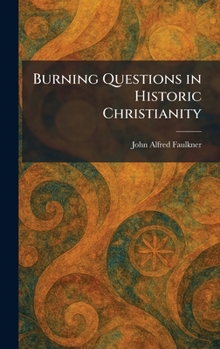
Burning Questions in Historic Christianity

"Burning Questions in Historic Christianity" offers a profound and scholarly exploration of the pivotal issues that have defined the Christian faith from its early stages through its historical development. John Alfred Faulkner, a noted historian of the church, addresses complex theological inquiries and controversial points of doctrine that have long sparked debate among scholars and believers alike.
The work examines critical themes such as the nature of early Christian communities, the evolution of church authority, and the historical circumstances surrounding the formation of fundamental creeds. By investigating these "burning questions," Faulkner provides a bridge between historical fact and theological significance, shedding light on how past conflicts and resolutions continue to influence modern religious thought. The text is characterized by its meticulous research and a clear, accessible style that invites readers to engage with the intellectual heritage of the Christian tradition.
Suitable for students of theology, church history, and religious studies, this volume stands as a testament to the importance of historical inquiry in understanding the foundations of faith. It remains a valuable resource for anyone seeking a deeper comprehension of the historical forces and ideological shifts that have shaped historic Christianity.
This work has been selected by scholars as being culturally important, and is part of the knowledge base of civilization as we know it. This work was reproduced from the original artifact, and remains as true to the original work as possible. Therefore, you may see the original copyright references, library stamps (as most of these works have been housed in our most important libraries around the world), and other notations in the work.
This work is in the public domain in the United States of America, and possibly other nations. Within the United States, you may freely copy and distribute this work, as no entity (individual or corporate) has a copyright on the body of the work.
As a reproduction of a historical artifact, this work may contain missing or blurred pages, poor pictures, errant marks, etc. Scholars believe, and we concur, that this work is important enough to be preserved, reproduced, and made generally available to the public. We appreciate your support of the preservation process, and thank you for being an important part of keeping this knowledge alive and relevant.
Customer Reviews
ThriftBooks® and the ThriftBooks® logo are registered trademarks of Thrift Books Global, LLC
