


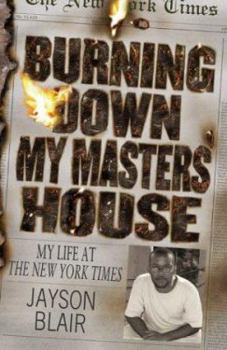
Burning Down My Masters' House: My Life at the New York Times

Select Format
Select Condition 
Book Overview
Blair recounts in detail the events that led to his downfall as a journalist for The New York Times, as well as his personal journey to make sense of the different pieces of the puzzle. This description may be from another edition of this product.
Format:Hardcover
Language:English
ISBN:193240726X
ISBN13:9781932407266
Release Date:March 2004
Publisher:New Millenium
Length:288 Pages
Weight:1.33 lbs.
Dimensions:9.5" x 1.3" x 6.5"
Customer Reviews
5 ratings
Don't buy a new copy...but still a great read
Published by Thriftbooks.com User , 16 years ago
Look...I didn't buy a new copy of this, and I would suggest either buying a used copy or getting it from the library..I don't believe he should profit off his misdeeds anymore than he has already. Despite that, this is a really good, page-turning read. It is what it is - a self-justifying, occasionally apologetic, sometimes unrepentant memoir of personal self-destruction. If you go in looking for that, I think it's really a strong piece of writing. I blazed through it becuase it was entertaining, and horrible all at the same time. What more do you want from a book like this, but voyueristic entertainment? There are blatant flaws, of course. Even beyond the fact that he's using drugs and booze (or even his efforts at recovery) to justify his laziness and depression, there are clear examples of backscratching - for instance, he does a lot of work to describe Police Chief Moose of the DC Sniper case....well, wouldn't you know it, now they both share a literary agent! Imagine that! There's lots of gossip and background info about the NY Times that anyone interested in journalism would want to read. The whole "dateline" issue was really amazing, and for all the criticism toward Blair personally, a lot of what he wrote in this book wasn't discredited. But, he is scummy and a liar. I would take every story he tells here with a grain of salt, and I assume many facts are exagerrated or plainly untrue. Or not. But who can say? And that's Blair's fault. He is the most sympathetic when he writes about stories he didn't plagiarize or fabricate - or even if he fabricated that he was in a specific location, he still did a good job gathering information and details. He probably could have been a great reporter - had he gotten off his couch and actually done the job he was being paid for. So...buy a new copy of the book, and give him financial support? Absolutely not. But, get it used from a small book dealer, and read a pretty well-written and certainly riveting account of one man's comeplete, self-inflicted personal devastation? I would strongly recommend it.
A good book
Published by Thriftbooks.com User , 21 years ago
I didn't decide to pick up this book until it made it onto the New York Times bestseller list in early April. I figured that if its sales were able to reach No. 32 on the bestseller list, at least some people might find Blair's story interesting. I had read a positive review in the Amsterdam News, but I still was wary because of other more critical reviews. Just by standing up and agreeing to face the wolves and offering what is sincerely and apologize, I give Blair some credit, but what made this book strong was that he provided insight on the general problems that people in all sorts of areas -- law enforcement, government, corporations and journalism -- face.
Jayson has something to say on race...read before you review
Published by Thriftbooks.com User , 21 years ago
(...)P>Coming from a fellow journalist in his age group, I really related to his story. For many journalists - and you do have to be a certain personality to be attracted to and endure this job - the work can send you into a tailspin. You take it home with you, it occupies your life and mind. Depending on what you write about, it can make you hypersensitive, paranoid, and full of anxiety. The New York Times had an Employee Assistance Program. Most newspapers do not have such resources and many young reporters have to learn on their own how to deal with the stresses of the job - taking it home with you, losing sleep because you are afraid you libeled someone, witnessing tragedy upon tragedy day in and day out, and having to distance yourself from it when your instinct is really to help. That's why you became a journalist.<p>Drug use is rampant. Most reporters and editors I know smoke pot regularly or did at one point, and drink like fish, and you wonder how many are into harder stuff. I am sure there are many (...) reporters out there who have not been caught yet. For many others, they haven't reached that point and perhaps never will, but still have their own coping mechanisms that may be detrimental to thorough and fair coverage.<p>One thing that I haven't seen on any TV interview or book review yet is anyone addressing the racial issues in the media - newsrooms and news reports - as Blair has. Blair does not simply use race as a scapegoat - he expresses interest in the effects that violence and oppression play throughout generations, be it upon Black, Jewish, Native American communities, etc. No one wants to talk about that though.<p>No one wants to talk about the decisions made at a daily newspaper, where the murder of a poor young Black man is called "garden variety" but a white kid bringing an unloaded gun to a suburban school is front page news. No one wants to talk about how that affects the psyche and confidence of black and other underrepresented reporters and the effects on their self-esteem. It is a shock to the system particularly for a generation of people who were born after the civil rights movement, who thought that being able to move into any neighborhood and vote meant that we would be viewed equally. It's not so folks.<p>I also have to say that no matter how (...) Jayson got, his writing is nice. It's not too flowery like a lot of the Times' journalists who have authored books, and he is good at summing up complexities in one or two sentences.<p>Perhaps the greatest sadness is that it had to come to Jayson self-destructing and deceiving people in order for him to come out and tell the truth. It's something more of us journalists should be willing to do, but we don't, and I am one of the guilty. As Jayson points out in his book, it is because most of us are too concerned with writing the stories that will get us on the front page and noticed rather than focusing on the matters that led us to become journalists. You can't blame i
Fascinating insight into the most powerful U.S. newspaper
Published by Thriftbooks.com User , 21 years ago
The New York Times was caught red-handed practicing its questionable brand of journalism. Only its immense power in controlling the media has kept the lid on the scandal. Blair provides a rare look inside the inner workings of this giant. Read this book to find out how the information you get from the mainstream media is twisted, shaped and formulated to suit the powers that be.
Harrowing Personal Story
Published by Thriftbooks.com User , 21 years ago
A lot of people have asked who is the master of the house that Jayson Blair says he burned down? He answers that question in the preface of his book: he is the master of the house that burnt down and in the pages that follow him explains in intense and candid detail that deceptions that he committed that damaged so many people. Blair is an admitted fabricator, but there is no reason not to believe him on these pages -- he comes off as honest in this account, sharing details that only a person who wants to come clean would share. In the course of writing this memoir, Blair dishes out interesting inside gossip about how The New York Times works. I am personally a fan of the paper, but I will never look at it the same way -- I will always wonder how decisions are made in that newsroom that impact the entire world. There are many examples of them dropping the ball. But this book is first and foremost and powerful personal story of a young man with so much promise who lost control of his life. That is something that so many Americans can relate to -- Americans of all colors. I applaud him for writing this book. The one downside is that it was clearly write in a bit of haste, but there are sparks of amazing writing. Blair makes no bones about the fact that he was the master of his own house, the master of his own destiny and he burned it down. This is also a book that should be read in classrooms. Not necessarily journalism classes, but in psychology, mental health and sociology classrooms. I cannot wait for the movie
Copyright © 2026 Thriftbooks.com Terms of Use
| Privacy Policy | Do Not
Sell/Share My Personal Information | Cookie Policy | Cookie Preferences | Accessibility Statement
ThriftBooks® and the ThriftBooks® logo are registered trademarks of Thrift Books Global, LLC
ThriftBooks® and the ThriftBooks® logo are registered trademarks of Thrift Books Global, LLC
