


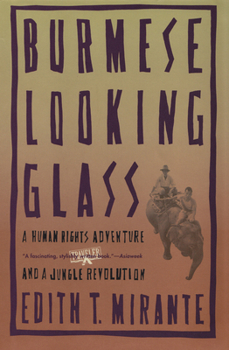
Burmese Looking Glass: A Human Rights Adventure and a Jungle Revolution

Select Format
Select Condition 
Book Overview
As captivating as the most thrilling novel, Burmese Looking Glass tells the story of tribal peoples who, though ravaged by malaria and weakened by poverty, are unforgettably brave. Author Edith Mirante first crossed illegally from Thailand into Burma in 1983. There she discovered the hidden conflict that has despoiled the country since the close of World War II. She met commandos and refugees and learned firsthand the machinations of Golden Triangle narcotics trafficking. Mirante was the first Westerner to march with the rebels from the fabled Three Pagodas Pass to the Andaman Sea; she taught karate to women soldiers, was ritually tattooed by a Shan "spirit doctor," has lobbied successfully against U.S. government donation of Agent Orange chemicals to the dictatorship, and was deported from Thailand in 1988.
Format:Paperback
Language:English
ISBN:0871135701
ISBN13:9780871135704
Release Date:April 1994
Publisher:Atlantic Monthly Press
Length:352 Pages
Weight:1.15 lbs.
Dimensions:0.9" x 6.1" x 9.2"
Customer Reviews
3 ratings
Impressive..........
Published by Thriftbooks.com User , 24 years ago
It took we a while to warm up to Ms. Mirante. As the story unfolds, one has cause to suspect a liberal, bleeding-heart hand wringer. But, this isn't any emotive flutterer afraid to mar her pedicure. This is a jungle-tramping, malaria-be-damned, human rights activist commando.In the late '80's, Mirante traveled to Thailand to enhance her art career. She soon became aware of the human rights abuses perpertrated in Burma at the hands of the Tatmadaw, the Burmese government army under the control of socialist despot, Ne Win. Putting her art aside, she quickly adopts the cause of the Burmese hill tribes subject to brutal repression and in fear of cultural obliteration. Mirante courageously risks life and limb as she illegally moves among the Burmese tribes recording their stories for disbursal to the outside world. Undaunted, intrepid, unfailingly committed, Mirante catalogs the abuses of Ne Win, offers hope and assistance to the refugees, and battles valiantly to make their story known.Though she casts some political aspersions stateside that she fails to adequately defend, Mirante manages to write this story without recourse to the shrill and idle finger pointing one might typically uncover in such a book. In fact, any doubts of this woman's admirable pragmatism are shattered when she admits to loathing the song, "We are the World". One is left thinking that she finds the song a piece of overwrought theater blissfully (and, perhaps, all too conveniently) ignorant of life in the human rights trenches.Edith T. Mirante is a remarkable woman deserving the esteem of every lover of liberty. She writes a good book and fights a good fight and, for that, I say more power to her.
Dining with drug lords and fighting for democracy
Published by Thriftbooks.com User , 25 years ago
I read Burmese Looking Glass about one year ago, after I had visited the Thai-Burmese border refugeee camps. I wish I had read it beforehand! This is an immensely informative narrative covering many aspects of the complicated and tragic situation in Burma, from underground pro-Democracy activists to drug lords to jungle warfare and women warriors. Its somewhere between political intrugue, war journalism, and travelogue. Much of what she reports is consistent with what I have learned from Burmese students in exile and pro-democray activists in the US and Thailand. I admire her chutzpah and honesty in painting this portrait of a horrendous and confusing situation as well as of herself. I found it totally readable, exciting, and inspiring.
Part Travel Story, Part Burmese Scorecard
Published by Thriftbooks.com User , 25 years ago
Edith Mirante's travel goals are pretty much similar to mine - see and report honestly, ignore travel hype, live as the locals, learn about political constraints, try to be sensitive to my gigantic country's effect on people in places where there are few American eyes. Are the people I meet in danger? Are they happy? Are they above the level of survival? Are they threatened by officials? For the reader who routinely asks such questions, Edith Mirante is the ideal travel guide. She rewrites the definition of "intrepid." She goes where no Americans are allowed, walking for days on blisters to visit Karen tribespeople, traveling clandestinely in hill country for the chance to meet a famous druglord and understand how the "Myanmar" army thugs have forced hill tribes to grow opium in place of crops. She braves Thai jail in order to push the envelope, sensing the most profound truths may lie just beyond those travel restrictions. They often do. Everywhere she manages to go, she tells us whom she sees, and what she hears. Everything Edith does stems from relationships. Edith brings gifts to her hosts. She is polite. She is properly outraged when she discovers mistreatment of the people she visits. And most of all, she goes the extra distance to return and hold her own American government responsible for mishandling the regional situation to the point of destruction. Most of us will never be able to travel to the places Edith takes us. If we did, there would be still fewer of us who could understand what we found when we got there. Since I read this book a year ago I have been surprised by how often I hear news items about Burma. What I hear often echoes the book. There are the accounts of farmers enslaved by the Burmese government to dig a pipeline for an American oil company - the farmers are now suing the oil company for enslavement in American court. Two young Karen brothers have had their pictures on the cover of a large-circulation American magazine for their desperate attempts to win back their lands and safety from the "Myanmar" army, which demands the complete destruction of all hill tribes. A much-beloved Burmese leader remains under house arrest. And, of course, American citizens are regularly requested to boycott American firms doing business with the brutal Burmese government. Burma may be half a world from the West. But it is no longer sufficient for westerners to rely on ignorance. It may be argued that increased worldwide communication allows us to be compassionate in new ways. We cannot all go to Burma to find out what is happening there. That is why a book like this is so valuable. Edith Mirante has already been there. She has done some of the preliminary footwork for the rest of us.
Copyright © 2026 Thriftbooks.com Terms of Use
| Privacy Policy | Do Not
Sell/Share My Personal Information | Cookie Policy | Cookie Preferences | Accessibility Statement
ThriftBooks® and the ThriftBooks® logo are registered trademarks of Thrift Books Global, LLC
ThriftBooks® and the ThriftBooks® logo are registered trademarks of Thrift Books Global, LLC
