


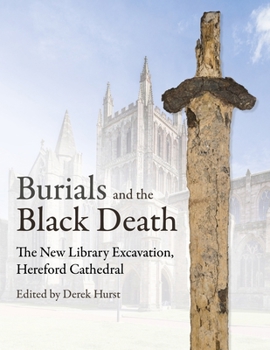
Burials and the Black Death: The New Library Excavation, Hereford Cathedral
No Customer Reviews

Presents new structural evidence for Saxon Hereford, a possible nunnery and bishop's residence, and its ransacking in 1055 by the Welsh.
Excavation at Hereford Cathedral in 1993, prior to the construction of the Mappa Mundi Museum and a new archive library, revealed extensive archaeological remains, commencing with 8th/9th-century buildings and a Saxon cemetery. In the 10th century a well-metalled road surface was constructed. Alongside this, a very substantial building arose, partially built in stone, and with a cellar. Its scale and design indicated this to be the bishop's residence. It was, however, remarkably short-lived. Its cellar became a cesspit, a pattern-welded sword lay on its floor, and overlying fills included an ornate inkwell, and a collection of animal carcasses. Radiocarbon dating suggests the Welsh ransacking of Hereford in 1055 as the context, recorded in historical evidence as disastrous for the cathedral.
The site of the cellared building was later quarried for aggregate, which accords well with major building works during the Norman period, most notably the Losinga Chapel and the new cathedral. A vast amount of mostly Saxon charnel was incorporated into backfilling the quarry, its final deposition being accompanied by inhumation burials, some being irregular. The latter may be linked to the violent hostilities in Hereford (c 1140) during the Anarchy.
From the mid-12th century the site wholly became a cemetery area, and the excavation of about 1000 burials has provided a full cross-section of the medieval population, with their analysis covering aspects such as health, stature and even origins. In the 14th century, three mass burial pits occurred, with dating consistent with the first outbreak of plague, the 'Black Death', in 1349. Associated analysis has contributed to an international study, successfully using ancient DNA analysis to identify the presence of Yersinia pestis, the plague microbe.
This report includes detailed reporting on the finds, particularly the human remains, with the interpretation of the entire stratigraphic sequence underpinned throughout by extensive radiocarbon dating and chronological modelling.
Excavation at Hereford Cathedral in 1993, prior to the construction of the Mappa Mundi Museum and a new archive library, revealed extensive archaeological remains, commencing with 8th/9th-century buildings and a Saxon cemetery. In the 10th century a well-metalled road surface was constructed. Alongside this, a very substantial building arose, partially built in stone, and with a cellar. Its scale and design indicated this to be the bishop's residence. It was, however, remarkably short-lived. Its cellar became a cesspit, a pattern-welded sword lay on its floor, and overlying fills included an ornate inkwell, and a collection of animal carcasses. Radiocarbon dating suggests the Welsh ransacking of Hereford in 1055 as the context, recorded in historical evidence as disastrous for the cathedral.
The site of the cellared building was later quarried for aggregate, which accords well with major building works during the Norman period, most notably the Losinga Chapel and the new cathedral. A vast amount of mostly Saxon charnel was incorporated into backfilling the quarry, its final deposition being accompanied by inhumation burials, some being irregular. The latter may be linked to the violent hostilities in Hereford (c 1140) during the Anarchy.
From the mid-12th century the site wholly became a cemetery area, and the excavation of about 1000 burials has provided a full cross-section of the medieval population, with their analysis covering aspects such as health, stature and even origins. In the 14th century, three mass burial pits occurred, with dating consistent with the first outbreak of plague, the 'Black Death', in 1349. Associated analysis has contributed to an international study, successfully using ancient DNA analysis to identify the presence of Yersinia pestis, the plague microbe.
This report includes detailed reporting on the finds, particularly the human remains, with the interpretation of the entire stratigraphic sequence underpinned throughout by extensive radiocarbon dating and chronological modelling.
Format:Hardcover
Language:English
ISBN:1789258685
ISBN13:9781789258684
Release Date:May 2026
Publisher:Oxbow Books Limited
Length:416 Pages
Weight:3.88 lbs.
Dimensions:1.2" x 8.6" x 12.0"
Customer Reviews
0 rating
Copyright © 2026 Thriftbooks.com
Terms of Use | Privacy Policy | Do Not Sell/Share My Personal Information | Cookie Policy | Cookie Preferences | Accessibility Statement
ThriftBooks ® and the ThriftBooks ® logo are registered trademarks of Thrift Books Global, LLC
ThriftBooks ® and the ThriftBooks ® logo are registered trademarks of Thrift Books Global, LLC
