


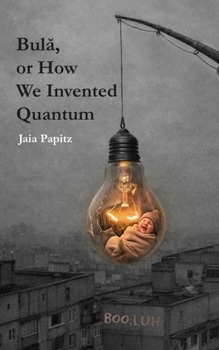
Bulă, or How We Invented Quantum

A child is born during a blackout. He does not cry; he laughs. It is a sharp, dry sound like a match struck on concrete, a noise that bends the metal bars of his crib and ripples the fabric of a world already stretched thin by silence. This is Bulă, a folkloric fool reimagined as a quantum anomaly-the accidental glue in a reality that has forgotten how to function.
Bulă, or How We Invented Quantum is a work of uncompromising absurdism. It sits at the intersection of brutalist reality and speculative philosophy, moving between the grit of human endurance and the cold mechanics of a celestial bureaucracy. The narrative explores a world where the state attempts to stabilize existence through a Ministry of Laughter Normalization, classifying amusement as a radioactive isotope of hope. Here, God is an exhausted engineer managing a leaking Big Bang while an unpaid intern mops up misplaced miracles . Nature itself glitches under the weight of human grief, resurrecting dead sparrows to walk in endless circles and allowing apartment walls to swallow the very plaster meant to fix them .
In this reality, even time eventually files for retirement, leaving only the misplaced timing of a boy's laughter to keep the stars from falling. Jaia Papitz delivers a profound meditation on what remains when the systems we trust-political, physical, and divine-begin to rot. This is a modern myth for those who know that even in a collapsing cosmos, a well-placed joke can rewrite the laws of physics. It is a story for readers of Franz Kafka, Mikhail Bulgakov, and the sharp edge of philosophical satire.
Customer Reviews
ThriftBooks ® and the ThriftBooks ® logo are registered trademarks of Thrift Books Global, LLC
