


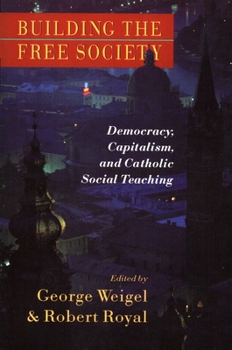
Building the Free Society: Democracy, Capitalism, and Catholic Social Teaching


Select Format
Select Condition 
Book Overview
Through the insightful and thought- provoking commentaries of ten distinguished Catholic writers, Building the Free Society critically examines a century of Catholic reflection and argument on human freedom, the just society, and the international order. Adopting the best from A Century of Catholic Social Thought , published in 1991 by the Ethics and Public Policy Center, this substantially revised, updated, and expanded volume focuses on the eleven key documents of modern Catholic social doctrine, beginning with Pope Leo XIII's encyclical Rerum Novarum (1891) and concluding with Pope John Paul II's revolutionary Centesimus Annus (1991). Renowned theologian Richard John Neuhaus opens the book with a challenging foreword on Christians as "resident aliens" of any earthly city, setting the tone for the compelling essays that follow. Contributors : William Murphy Thomas C. Kohler Robert A. Sirico George Weigel Mary Eberstadt Kenneth L. Grasso Robert Royal James Finn Robert A. Destro William McGurn
Format:Paperback
Language:English
ISBN:080280120X
ISBN13:9780802801203
Release Date:October 1993
Publisher:Eerdmans Publishing Company, William B.
Length:268 Pages
Weight:0.81 lbs.
Dimensions:0.7" x 6.0" x 9.0"
Customer Reviews
2 ratings
Personalist v. Liberal Democracy
Published by Thriftbooks.com User , 16 years ago
I just finished reading this collection of essays on Catholic Social Teaching. Each essay is by an different author and comments on a particular social encyclical. This isn't to say the essays are merely summaries; each one critically examines the strengths and weaknesses of the encyclical it addresses. I found the essay on the Declaration on Religious Freedom especially helpful. The author distinguishes three stages in the Catholic understanding of Church-State relations: Stage 1: The Throne and Altar arrangement. This is the time of religious establishment as the Monarch and Church both endorse each other. The French called it the Ancien Regime, the Old Order. The problem with this arrangement, from my perspective, are twofold. First, the monarch ends up wanting to control the Church e.g. investiture controversy. Second, the Church's fortunes are tied up with the existing regime. If the monarch makes a mistake, then in the eyes of the people the Church is guilty by association. This is what happened in the French Revolution. Stage 2: Continental Liberalism. This is the worldview of the thinkers behind the French Revolution: Democracy, autonomous individualism, and human rights. In the name of these ideas, the Revolutionaries unleashed the Reign of Terror and De-Christianization. It was these atrocities which were in the minds of churchmen when they opposed liberalism until Vatican II. Stage 3: American Liberalism. A Jesuit, John Courtney Murray, argued that there was another form of liberalism which respected religion and would not lead to atrocities associated with Continental Liberalism. The Catholic Church had done well in America, even though it was a primarily Protestant Country. This occurred because the state did not establish any particular religion in the United States. Murray urged the Church to embrace this form of liberalism and in Vatican II's Dignitatis Humanae, she did. The battle between the American (Personalist) and Continental (Liberal Individualist) meaning of democracy continues. It is occurring within America and the rest of the world generally. The first meaning views human beings as persons: social beings with rights AS WELL AS corresponding duties. Moreover, Personalist Democracy presupposes a transcendent reference point which is the source of our moral obligations. In contrast, the Liberal Individualist model sees humans as autonomous, self-interested beings. The source of moral obligations is either consent or utility. The collection of essays is filled with interesting discussions like the one above. It was a difficult, but helpful, book to read.
In praise of subsidiarity
Published by Thriftbooks.com User , 18 years ago
~Building the Free Society: Democracy; Capitalism, and Catholic Social Teaching~ is an erudite exposition upon Catholic Social Thinking. I got this book a few years ago, because it echoed a theme analogous to agrarian literature which esteemed the principle of subsidiarity, or as Protestants such as Abraham Kuyper dub it, sphere sovereignty. Subsidiarity is the principle which states that matters ought to be handled by the smallest (or, the lowest) competent authority. This principle applied to a body politic, precludes a managerial regime or welfare state, and centralized schemes of wealth redistribution. At its core, Catholic Social Thought recognizes the family as the basic inviolable unit of society and gives deference to those intermediary institutions between the individual and the state. Pope Pius XI's most definitive encyclical was Quadragesimo Anno issued 15 May 1931, 40 years after Rerum Novarum (thus the name, Latin for 'in the fortieth year'). Written as a reactionary response to the cultural and economic wasteland that befell Europe and America amidst the Great Depression, it calls for the establishment of a social order based on the principle of subsidiarity. The encylical observes, "We once had a prosperous social system which owed its development to the wide variety of associations, organically linked together. That structure has been overturned and all but demolished. Individuals are left alone with the state." I personally detest the contemporary American political culture and its inflationary entitlement state. Collectively the middle class takes the biggest hit. The super-wealthy benefit by the inflationary state, and multiple their wealth by illicit gain and monetary manipulation to the detriment of the working middle class. The downtrodden urban masses are placated by the state that plunders the rest to appease them. Collectively, the middle class takes the biggest pinch. Ironically, the social conditions for a nation to achieve a humane economy requires a broad-based distribution of private property, and these social conditions are best realized in societies that embrace subsidiarity and structural decentralization in its political edifices and organizations. Coerced redistribution is not the desirable means of achieving this end; but rather a slow natural development over the course of time within a decentralized polity. Contemporaneously, all of the useless politicians that pander to the base instincts of human nature, promising the spoils of legal plunder to be given to the downtrodden are part of the problem. The Robin Hood state destroys character, inculcates idleness, stifles individual initiative, saps the nation of its economic and social vitality, and ultimately makes slaves of its dependents. The potential for a more prosperous social order is realized by a society that embraces subsidiarity, not socialism. Welfare-statism is utterly incompatible with human condition. That housing projects have a revolving door
Copyright © 2026 Thriftbooks.com
Terms of Use | Privacy Policy | Do Not Sell/Share My Personal Information | Cookie Policy | Cookie Preferences | Accessibility Statement
ThriftBooks ® and the ThriftBooks ® logo are registered trademarks of Thrift Books Global, LLC
ThriftBooks ® and the ThriftBooks ® logo are registered trademarks of Thrift Books Global, LLC
