


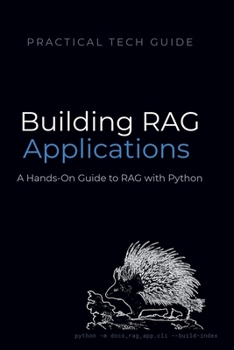
Building RAG Applications: A Hands-On Guide to Retrieval-Augmented Generation with Python

Build practical RAG applications without getting lost in vendor noise.
Retrieval-Augmented Generation, or RAG, is one of the most useful patterns for building AI applications that answer from real documents instead of unsupported guesses. But many explanations jump too quickly into tools, vector databases, and frameworks before explaining how the system actually works.
This book takes a practical, project-first approach.
You will build docs_rag_app, a small local RAG application in Python that answers questions over a folder of documents. Step by step, you will learn how to load documents, split them into chunks, retrieve relevant evidence, generate grounded answers, add citations, evaluate quality, and debug bad results.
Along the way, the book explains the ideas behind the code:
why LLMs need retrievalhow RAG differs from fine-tuning, long context, memory, and tool callshow chunking affects answer qualityhow lexical and vector retrieval workwhy reranking improves difficult caseshow citations and abstention reduce hallucination riskhow to evaluate and refresh a RAG systemwhy retrieved text should be treated as evidence, not trusted instructionsThe goal is not to build the largest possible AI system. The goal is to build a small RAG application that is easy to inspect, easy to debug, and strong enough to improve.
If you can read basic Python and want to understand how retrieval changes AI application design, this guide gives you a clear path from first working prototype to practical local RAG app.
Customer Reviews
ThriftBooks ® and the ThriftBooks ® logo are registered trademarks of Thrift Books Global, LLC
