


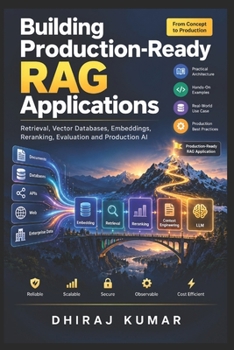
Building Production-Ready RAG Applications: Retrieval, Vector Databases, Embeddings, Reranking, Evaluation and Production AI

Retrieval-Augmented Generation has become one of the most important architectures for building applications powered by Large Language Models.
But production RAG is much more than connecting an LLM to a vector database.
A reliable RAG application must retrieve the right information, construct useful context, generate grounded responses, evaluate its own quality, control latency and cost, protect sensitive data, and handle failures safely.
Building Production-Ready RAG Applications takes you from RAG fundamentals to a complete production-oriented architecture.
Inside the book, you will learn how to build and reason about:
RAG architecture and retrieval pipelinesEmbeddings and semantic searchDocument parsing and intelligent chunkingVector databases and similarity searchHybrid retrievalReranking and advanced retrieval strategiesQuery rewriting and query expansionContext engineeringLLM-based grounded generationCitations and hallucination controlsRAG evaluation and RAGAS-style metricsObservability and tracingCaching and performance optimizationLatency, scalability and cost optimizationPrompt injection and indirect prompt injectionData poisoning and retrieval poisoningPII protection and authorization-aware retrievalMulti-tenant securityGuardrails and abstentionProduction deployment and failure handlingThe book uses a practical NovaShop scenario to connect individual concepts into a realistic end-to-end RAG system.
You will progressively move from:
Documents → Chunks → Embeddings → Search → Retrieval → Reranking → Context → LLM → Validation → Guardrails → Evaluation → Monitoring
to a complete production architecture.
Whether you are a Data Engineer, Software Engineer, ML Engineer, AI Engineer, or developer entering Generative AI, this book focuses on the engineering decisions required to move from a working prototype to a dependable AI application.
Learn the architecture. Build the system. Measure the results. Make it production-ready.
KDP advises that descriptions should accurately represent the book and should not contain promotional claims, URLs, reviews, or keyword stuffing.
Customer Reviews
ThriftBooks ® and the ThriftBooks ® logo are registered trademarks of Thrift Books Global, LLC
