


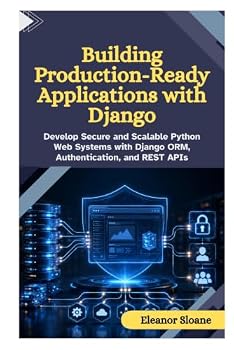
Building Production-Ready Applications with Django: Develop Secure and Scalable Python Web Systems with Django ORM, Authentication, and REST APIs

A working website is only the beginning. The real challenge is building one that remains secure, maintainable, and dependable when real users and real data arrive.
Building Production-Ready Applications with Django takes you from the foundations of server-side development to the practical engineering decisions required to build complete database-backed web systems.
Rather than treating routing, databases, user accounts, APIs, security, testing, and deployment as unrelated subjects, this book shows how they fit together inside one structured application.
You will begin by creating a clean development environment and understanding how requests move through URLs, views, templates, and models. From there, you will learn how to design persistent data, manage schema changes safely, query relational information efficiently, process forms, validate user input, and build reusable page structures.
As the application develops, you will work with:
Models, relationships, migrations, and efficient data queries
Forms, validation, file uploads, and CSRF protection
Built-in administration tools and permission management
Registration, login, logout, groups, ownership, and access control
Function-based and class-based views
Pagination and user feedback
REST endpoints, serializers, ViewSets, and routers
API permissions, filtering, throttling, and pagination
Protection against common application security risks
Automated tests for models, views, forms, authentication, and APIs
Debugging and production logging
Query optimization, caching, and scalability techniques
Static and media file handling
WSGI and ASGI deployment
HTTPS, production settings, databases, and post-deployment verification
Throughout the book, a Team Task Manager grows from an empty project into a complete multi-user system. Users can create accounts, work with projects and tasks, interact through traditional web pages, and access controlled application data through an API. Ownership and permission rules ensure that protected information remains restricted to the appropriate users.
The later chapters move beyond development convenience and address what happens when software must operate outside your local machine. You will learn how to measure performance before optimizing, reduce inefficient database access, prepare production configuration, protect secrets, manage static assets, configure deployment interfaces, inspect logs, and verify that a release actually works after it goes live.
The goal is not simply to memorize framework commands. It is to understand the structure behind reliable web software so you can make better engineering decisions as your applications become larger and more demanding.
Whether you are progressing beyond basic Python projects or already know the fundamentals and want a more systematic approach to web development, this book gives you a practical path from your first project configuration to a secured, tested, production-conscious application.
Build applications that do more than run locally. Build them with the structure, security, and discipline required to grow.
Customer Reviews
ThriftBooks ® and the ThriftBooks ® logo are registered trademarks of Thrift Books Global, LLC
