


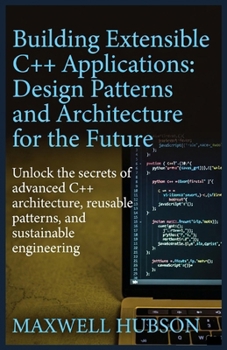
Building Extensible C++ Applications: Design Patterns and Architecture for the Future: Subtitle: Unlock the secrets of advanced C++ architecture, reus
No Customer Reviews

In the ever-shifting terrain of software engineering, where technologies rise and fall with alarming rapidity, C++ endures as a bedrock language for systems that demand unyielding performance, precise control over resources, and the capacity to scale across domains as diverse as embedded devices, high-frequency trading platforms, game engines, and cloud-scale distributed services. Introduced by Bjarne Stroustrup in the early 1980s as "C with Classes," C++ has evolved through multiple standardization cycles, each infusing the language with greater expressive power, safety guarantees, and abstraction mechanisms without sacrificing its core philosophy of zero-overhead abstractions. Today, with the ratification of C++20 and the ongoing development of C++23, the language stands at a pivotal juncture, offering features such as concepts, coroutines, ranges, and modules that fundamentally reshape how developers architect extensible applications.
Yet mastery of syntax alone does not suffice for crafting software that remains viable over decades. The true challenge lies in designing systems that accommodate unforeseen requirements, integrate with emerging technologies, and withstand the erosive forces of technical debt. Extensibility, in this context, transcends mere code modularity; it embodies a holistic engineering discipline that anticipates change, enforces clear boundaries between concerns, and leverages the language's capabilities to enforce invariants at compile time whenever possible. This book addresses that challenge head-on, providing a roadmap for transforming raw C++ proficiency into architectural excellence.
Yet mastery of syntax alone does not suffice for crafting software that remains viable over decades. The true challenge lies in designing systems that accommodate unforeseen requirements, integrate with emerging technologies, and withstand the erosive forces of technical debt. Extensibility, in this context, transcends mere code modularity; it embodies a holistic engineering discipline that anticipates change, enforces clear boundaries between concerns, and leverages the language's capabilities to enforce invariants at compile time whenever possible. This book addresses that challenge head-on, providing a roadmap for transforming raw C++ proficiency into architectural excellence.
Format:Paperback
Language:English
ISBN:B0G1C2QXLV
ISBN13:9798273480926
Release Date:November 2025
Publisher:Independently Published
Length:232 Pages
Weight:0.60 lbs.
Dimensions:0.5" x 5.5" x 8.5"
Customer Reviews
0 rating
Copyright © 2026 Thriftbooks.com
Terms of Use | Privacy Policy | Do Not Sell/Share My Personal Information | Cookie Policy | Cookie Preferences | Accessibility Statement
ThriftBooks ® and the ThriftBooks ® logo are registered trademarks of Thrift Books Global, LLC
ThriftBooks ® and the ThriftBooks ® logo are registered trademarks of Thrift Books Global, LLC
