


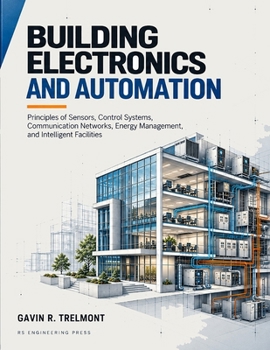
Building Electronics and Automation: Principles of Sensors, Control Systems, Communication Networks, Energy Management, and Intelligent Facilities
No Customer Reviews

Modern facilities depend on one continuous chain: sense the physical world, communicate reliable data, make a controlled decision, act safely, and verify the outcome.
That chain crosses electronics, measurement, controls, mechanical systems, networking, energy, software, cybersecurity, and operations. When those disciplines are studied in isolation, important failure modes disappear between them. A biased sensor, noisy signal, weak actuator, unstable loop, ambiguous data point, network delay, competing sequence, or untested override can undermine comfort, efficiency, resilience, and trust in the entire system.
This vendor-neutral engineering textbook connects the full sensor-to-decision-to-action lifecycle. It begins with circuits, signals, uncertainty, sensors, transducers, relays, drives, and power interfaces. It then develops embedded and programmable control, feedback behavior, tuning, state logic, communication networks, interoperable data, and supervisory sequences. The same framework is applied to heating, cooling, ventilation, lighting, shading, plug loads, metering, storage, distributed energy, connected analytics, secure operation, commissioning, and modernization.
What you will learnTrace measurements and commands through every layer of an integrated facility.Connect control theory to modes, interlocks, alarms, resets, overrides, and real equipment constraints.Evaluate sensor quality, actuator authority, network behavior, data meaning, and safe fallback states.Coordinate environmental quality, lighting, energy flexibility, resilience, and operational priorities.Use trends, functional tests, and diagnostic evidence to find root causes and verify performance.Plan upgrades with clear dependencies, security boundaries, documentation, and acceptance criteria.Key topics
Coverage includes electronics and measurement, field devices, digital controllers, feedback and sequence design, facility communications, semantic data, high-performance mechanical-system automation, lighting control, energy management, demand response, distributed resources, life-safety and security interfaces, wireless and edge systems, analytical methods, cybersecurity, commissioning, fault diagnostics, and staged facility modernization.
Who this book is for
Designed for upper-level engineering students, technologists, technicians, commissioning personnel, early-career controls professionals, energy specialists, and practicing engineers who need a rigorous bridge across building, control, network, and operations disciplines. Algebra and introductory physics are assumed; some calculus is useful. The material also supports instructors and multidisciplinary project teams that need a shared technical language for design reviews, sequence development, troubleshooting, functional testing, and upgrade planning.
Develop the systems-level reasoning to explain how an intelligent facility works, diagnose why it does not, and verify the performance of every improvement.
That chain crosses electronics, measurement, controls, mechanical systems, networking, energy, software, cybersecurity, and operations. When those disciplines are studied in isolation, important failure modes disappear between them. A biased sensor, noisy signal, weak actuator, unstable loop, ambiguous data point, network delay, competing sequence, or untested override can undermine comfort, efficiency, resilience, and trust in the entire system.
This vendor-neutral engineering textbook connects the full sensor-to-decision-to-action lifecycle. It begins with circuits, signals, uncertainty, sensors, transducers, relays, drives, and power interfaces. It then develops embedded and programmable control, feedback behavior, tuning, state logic, communication networks, interoperable data, and supervisory sequences. The same framework is applied to heating, cooling, ventilation, lighting, shading, plug loads, metering, storage, distributed energy, connected analytics, secure operation, commissioning, and modernization.
What you will learnTrace measurements and commands through every layer of an integrated facility.Connect control theory to modes, interlocks, alarms, resets, overrides, and real equipment constraints.Evaluate sensor quality, actuator authority, network behavior, data meaning, and safe fallback states.Coordinate environmental quality, lighting, energy flexibility, resilience, and operational priorities.Use trends, functional tests, and diagnostic evidence to find root causes and verify performance.Plan upgrades with clear dependencies, security boundaries, documentation, and acceptance criteria.Key topics
Coverage includes electronics and measurement, field devices, digital controllers, feedback and sequence design, facility communications, semantic data, high-performance mechanical-system automation, lighting control, energy management, demand response, distributed resources, life-safety and security interfaces, wireless and edge systems, analytical methods, cybersecurity, commissioning, fault diagnostics, and staged facility modernization.
Who this book is for
Designed for upper-level engineering students, technologists, technicians, commissioning personnel, early-career controls professionals, energy specialists, and practicing engineers who need a rigorous bridge across building, control, network, and operations disciplines. Algebra and introductory physics are assumed; some calculus is useful. The material also supports instructors and multidisciplinary project teams that need a shared technical language for design reviews, sequence development, troubleshooting, functional testing, and upgrade planning.
Develop the systems-level reasoning to explain how an intelligent facility works, diagnose why it does not, and verify the performance of every improvement.
Format:Paperback
Language:English
ISBN:B0HKGP4P2B
ISBN13:9798175922159
Release Date:September 2026
Publisher:Independently published
Length:433 Pages
Weight:2.20 lbs.
Dimensions:11.0" x 1.0" x 8.5"
Customer Reviews
0 rating
Copyright © 2026 Thriftbooks.com
Terms of Use | Privacy Policy | Do Not Sell/Share My Personal Information | Cookie Notice | Cookie Preferences | Accessibility Statement
ThriftBooks ® and the ThriftBooks ® logo are registered trademarks of Thrift Books Global, LLC
ThriftBooks ® and the ThriftBooks ® logo are registered trademarks of Thrift Books Global, LLC
